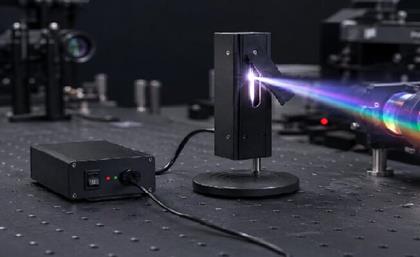
I. Working Principle and Configuration Scheme as a Backlight Source
1. Typical Operation Modes
a Absorption Spectroscopy Mode
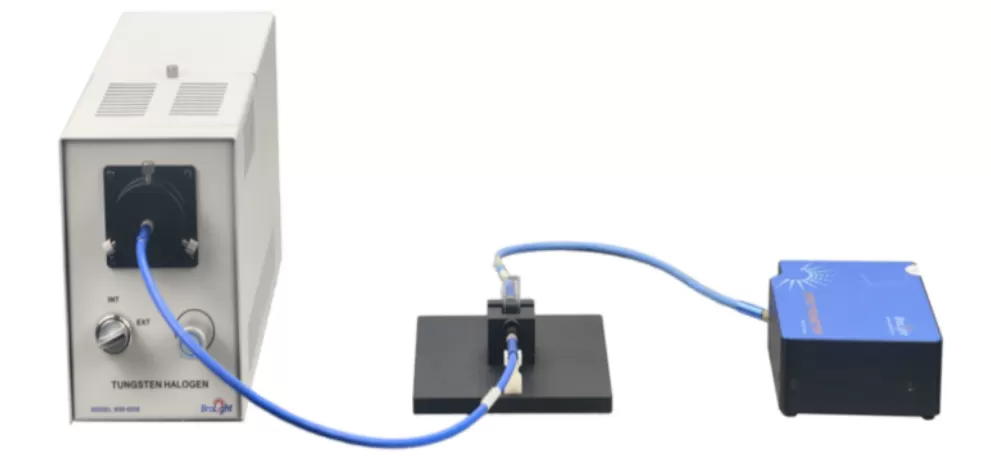
optical path configuration:
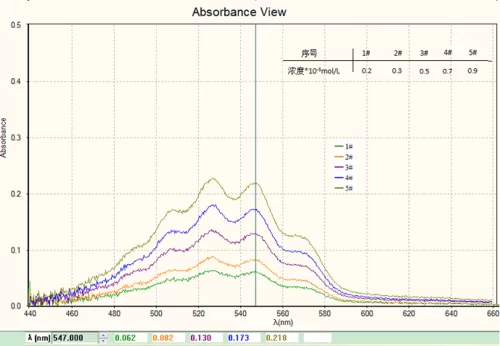
Absorbance Curves of KMnO₄Solutions at Different Concentrations
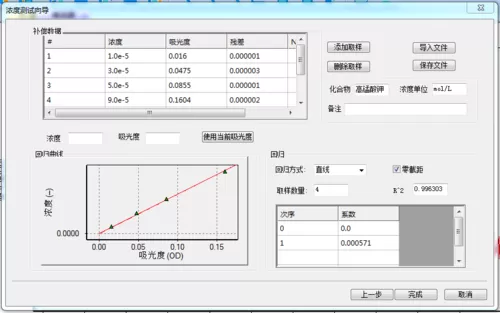
Determine the Concentration of Unknown KMnO₄ Solutions
● Workflow:
1. The source outputs a stable broadband continuous spectrum.
2. The light passes through a blank/reference sample (e.g., pure solvent or air).
3. The spectrometer records the transmitted background spectrum as the reference intensity.
4. The light passes through the sample under test.
5. The spectrometer records the transmitted spectrum. Characteristic absorption by the sample causes attenuation at specific wavelengths, yielding the sample intensity, I(λ).
6. The absorbance is calculated for each wavelength using the formula:
A(λ) = -log[I(λ)/I₀(λ)]
Sample Types:
1. Solution Samples
2. Transparent/semi-transparent solid sample
3. Diffuse Reflectance Measurement
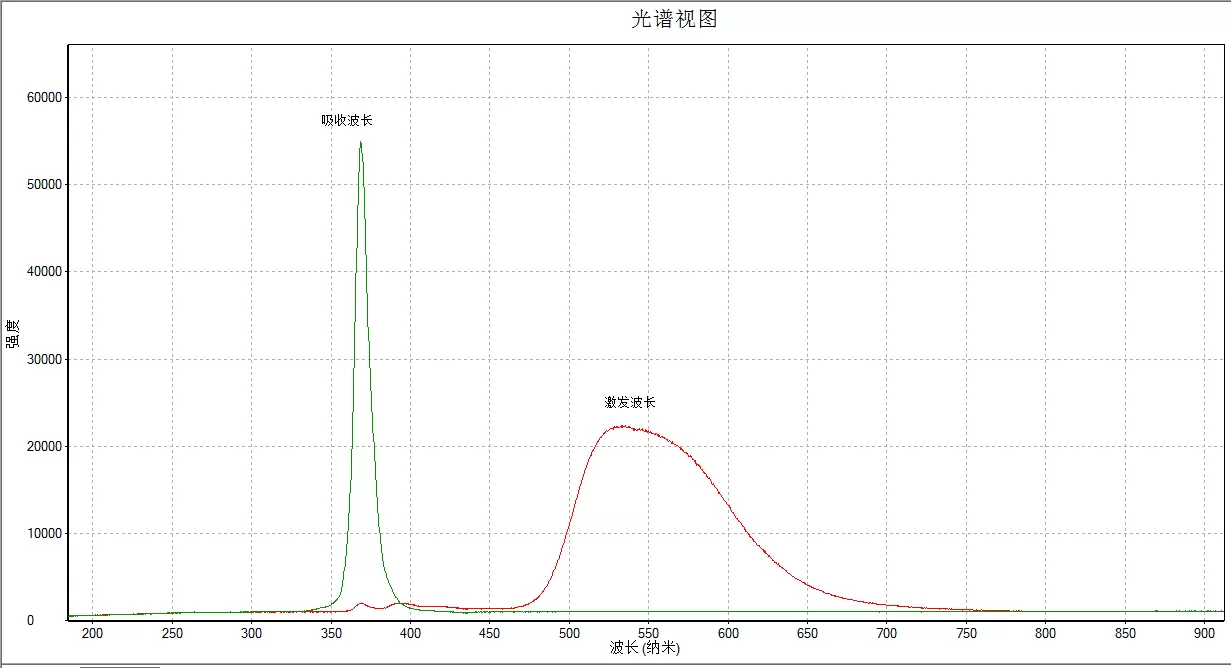
b Fluorescence Spectroscopy Mode
· Optical Path Configuration (Right-Angle Configuration)

Ink fluorescence spectrum
1. Light Source Control Scheme
Control needs | Implementation Methods | Advantages |
Power Stability | Front-panel potentiometer adjustment + 30-minute warm-up | Ensures backlight stability for consistent baseline and high signal-to-noise ratio (SNR). |
Synchronous Acquisition | PWM signal synchronized with spectrometer external trigger | Minimizes artifacts from fluorescence lifetime decay; |
Long-duration Experiments | 0–10 V analog voltage remote program control | Enables fully automated data acquisition sequences. |
Excitation Wavelength Scan | Integrate with a monochromator + external control (e.g., via software) | Facilitates fluorescence excitation spectrum measurement. |
II. Impact of Key Performance Indicators on Spectral Analysis
1. spectrum range (300-2500nm)
• 300–400 nm (Near Ultraviolet):
Suitable for absorption/fluorescence analysis of aromatic compounds and certain inorganic substances.
• 400–800 nm (Visible Range):
Covers the characteristic absorption of most organic dyes and biological molecules.
• 800–2500 nm (Near Infrared):
Applicable for NIR fluorescent probes and semiconductor material analysis.
2. Power stability (≤0.5%)
Impact on Absorption Spectroscopy
Transmittance (T = I/I₀)
Impact on Fluorescence Spectroscopy:
Directly affects the measurement repeatability of fluorescence intensity.
High stability is essential for accurate fluorescence quantum yield (Φ) calculations.
3. Maximum Radiant Power (≥50 W)
Advantages of the High Power:
Increases the Signal-to-Noise Ratio (SNR), particularly beneficial for samples with weak absorption or fluorescence.
Reduces spectral acquisition time, making it suitable for applications requiring short measurement response times.
Supports long-path sample cells or the measurement of high-concentration samples.
4. Control Flexibility
Analog Voltage Control (0-10 V):
Linear power adjustment, facilitating quantitative experimental design.
Compatible with integration into platforms such as LabVIEW and MATLAB.
PWM Control (0/10 V):
Supports synchronized output triggering with peripheral devices.
Controls output power by adjusting the duty cycle.
III. Best Operating Practices
1. Light Source Warm-up and Stabilization
Warm-up Time: ≥30 minutes
Stability Verification: Monitor reference detector signal; ensure fluctuation ≤0.5%
Environmental Requirements: Avoid drafts, vibrations, and temperature fluctuations
2. System Calibration Procedure
1. Dark Background Calibration: Turn off the light source and record the detector background.
2. Reference Spectrum Calibration: Use a standard sample or a blank sample.
3. Wavelength Calibration: Use a standard mercury lamp.
4. Intensity Calibration: Use a standard light source.
3. Data Quality Assessment Index
Absorption Spectroscopy:
Absorbance Accuracy
Absorbance Detection Limit
Characteristic Peak Reproducibility
Fluorescence Spectroscopy:
Characteristic Peak Reproducibility
Fluorescence Signal-to-Noise Ratio
IV. Troubleshooting and Maintenance
common issues | Possible cause | Solution |
Reference Spectrum Drift | Unstable light source power | Check power supply stability; Extend warm-up time. |
Decreased Signal-to-Noise Ratio | Lamp aging or contamination | Replace lamp; Clean optical windows. |
Weak Signal at Specific Wavelength | Low fiber coupling efficiency | Re-align fiber; Inspect connectors. |
V. Summary of Key Selection Criteria for Backlight Sources
Spectral Match: The source's spectral range must cover the characteristic absorption/emission bands of the sample.
Stability: Power fluctuations directly affect the accuracy of quantitative analysis.
Power Adjustability: Adapts to different sample concentrations and sensitivity requirements.
Control Interface: Supports synchronization and automation with spectral systems.
Lifetime: Lamp longevity impacts long-term experimental costs.
System Compatibility: Flexibility in mechanical interfaces and optical path configuration.
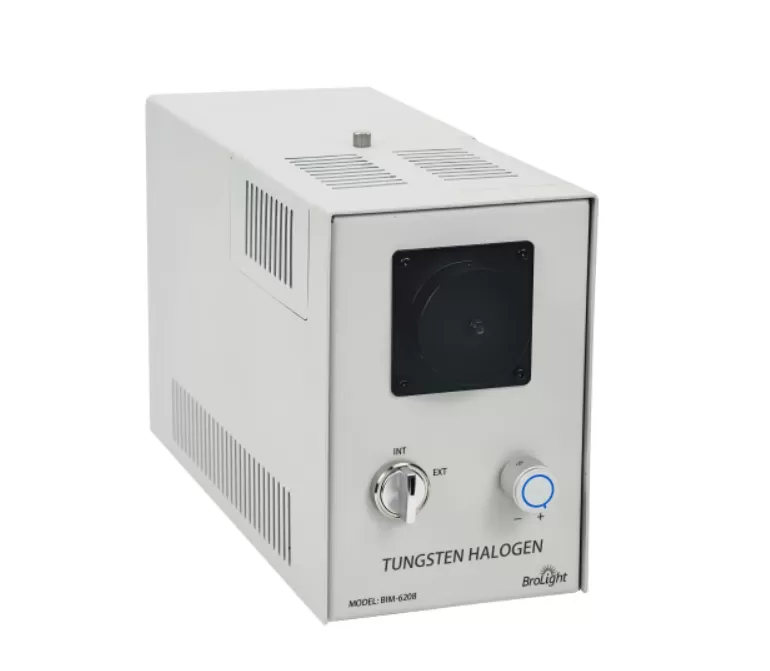
BIM-6208, with its broad spectrum, high stability, and flexible control, serves as an ideal backlight source for absorption/fluorescence spectral analysis. It is particularly well-suited for scientific research and industrial applications that require long-term stable measurements or complex experimental designs.
Advantages
Optimized Luminous Flux Efficiency
Flexible Output Configurations
Precise Power Adjustment
Simplified Maintenance and Operation
The light source is particularly suitable for demanding applications such as spectral analysis, optical inspection, and precision measurement systems requiring stable broadband radiation.
Features
Maximum Radiant Power > 50W
Optical Power Stability up to 0.5%
Power Remotely Controllable via External Signal
Supports Fiber Coupling and Free-Space Output
Easy Lamp Replacement and Maintenance
Application:
Photochemical Experiments
Photoelectric Device Characterization Testing
Solar Cell Research
Biological Illumination and Catalysis
Absorption and Fluorescence Spectroscopy Testing
Specifications:
Item | Parameters |
Spectrum range | 300~2500nm |
Bulb Power | 150 W |
Maximum power | ≥50W |
External Remote Control | analog signal control 1V~10V PWM signal control 0V/10V(L/H) |
Power Stability | ≤0.5% |
Average Lifespan | 500hours |
Operation Voltage | 200~240VAC |
Overall Dimensions | 275×115×170 mm |
 EN
EN
 jp
jp  ko
ko  fr
fr  de
de  es
es  tr
tr  ru
ru  pt
pt  ar
ar  vi
vi