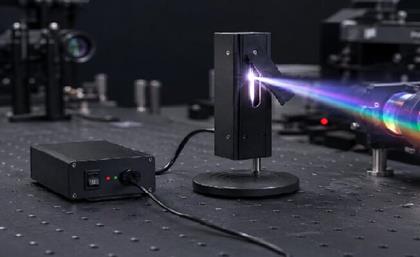
In the design, manufacturing, and application of semiconductor lasers (LDs), the laser divergence angle is a key parameter determining optical performance. It affects not only beam collimation and energy concentration but also directly relates to the coupling efficiency in optical systems, processing precision, and overall energy efficiency. Whether in fiber optics communications, material processing, medical lasers, or optical sensing, precise divergence angle measurement is fundamental for ensuring laser device performance and stable operation.
Why Measure the Laser Divergence Angle?
The divergence angle indicates how a laser beam spreads during propagation and directly influences:
· Coupling Efficiency: Excessive divergence reduces coupling efficiency into fibers or waveguides.
· Processing Quality: Affects focused spot size, determining machining accuracy and results.
· System Integration: Optical designs must match lenses and paths based on the divergence angle.
· Energy Management: Controlling divergence helps improve system energy efficiency and reduce losses.
Thus, precise divergence angle measurement is essential in R&D verification, quality inspection, and system integration.
The Breakthrough of Scanning Pinhole Method: From Traditional Technique to Intelligent Measurement
The scanning pinhole method is a classic intensity distribution measurement technique using mechanical scanning with pinhole sampling. Compared to beam profiling methods, it offers a larger measurement range and more data dimensions.
Building upon the traditional scanning pinhole principle, the BRM-6301 achieves comprehensive functional integration and intelligent enhancement:
Conventional M² Measurement System | BRM-6301 Innovative Solution |
Limited by scan range and imaging area; suitable only for small angles. | Full angular coverage: γ-axis ±90°, C-axis 0°–360°. |
Relatively single angular data output. | Integrated software automatically outputs polar/Cartesian coordinate distribution maps. |
Angular measurement mainly suitable for semiconductor lasers. | Designed for high-divergence LDs; supports LED intensity angular distribution measurement. |
Primarily for complete laser device measurement. | Supports common packaged laser devices and bare laser chip testing. |
Limited to angular data; cannot measure device-level parameters. | Synchronizes angle data with LD drive current, temperature, etc., enabling extended device characterization. |
High cost (>$15000). | Cost-effective. |
BRM-6301: The Intelligent Evolution of the Scanning Pinhole Method
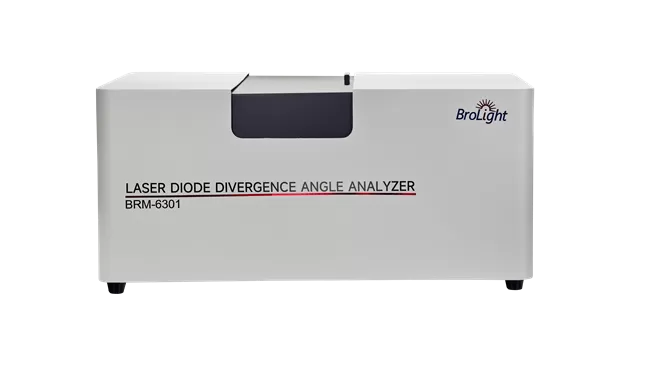
Figure 1: BRM-6301 Product Image
The BRM-6301 retains the structural stability and cost-effectiveness of the scanning pinhole method while achieving dual improvements in measurement efficiency and precision through fully automated control, a high-precision electromechanical system, and intelligent data processing algorithms.
Core Advantages:
· Direct High-Divergence Measurement: Overcomes traditional beam profiler limits; supports –90° to +90°, covering most LDs and LEDs.
· One-Click Fully Automated Scanning: Requires no manual intervention; automatically performs scanning, acquisition, analysis, and report generation, significantly improving efficiency and consistency.
· Dual-Coordinate Automated Plotting: Simultaneously generates both polar and Cartesian coordinate angular distribution maps through intelligent data processing.
· High Precision & Flexible Configuration: Angular accuracy ±0.1°, minimum step 0.1°. Supports detector selection for wavelengths from 200 nm to 1650 nm.
· Expandable Functionality: Can connect with BRM-610X series laser drivers and BRM-620X series temperature controllers for comprehensive parameter analysis like P-I-V, WPE, and threshold current.
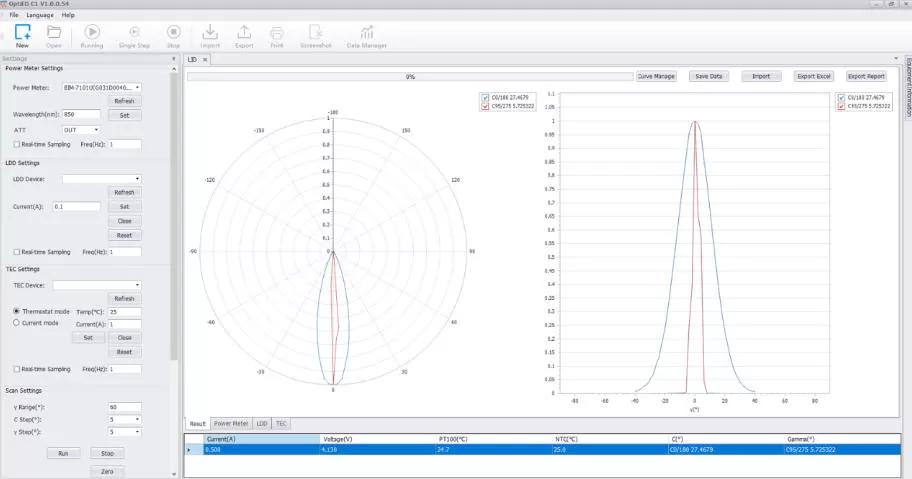
Figure 2: Typical Data
Application Scenarios:
· R&D testing and quality inspection of semiconductor laser (LD) divergence angles.
· LED intensity angular distribution evaluation and optimization.
· Comprehensive analysis of laser P-I-V characteristics and photoelectric performance.
· Various optical measurement environments: laboratories, production lines, teaching demos.
Key Specifications:
· Angular Range: γ-axis ±90°, C-axis 0°–360°
· Measurement Accuracy: ±0.1°
· Dimensions & Weight: 797 × 447 × 376.5 mm; 30 kg. Stable structure suitable for benchtop use.
Conclusion:
As optical measurement advances toward intelligence and efficiency, the BRM-6301 not only carries forward the reliability of the scanning pinhole method but also revitalizes it with automation and digitalization. It provides an accurate, efficient, and user-friendly integrated measurement experience for laser device R&D and production.
About Us
Brolight, an independent brand under A&P Instrument, focuses on the R&D, manufacturing, and integrated solutions of photonics testing equipment and lab instruments. Leveraging A&P Instrument's over 40 years of technological heritage and market expertise in the photonics industry, Brolight precisely addresses the diverse needs of scientific research, industrial inspection, and experimental teaching. With exceptional photonics products and lab instruments, we build a reliable and efficient application foundation for research institutions, industrial enterprises, and educators worldwide.
Learn More
Contact sales@brolight.cn for detailed information and technical consultation.
 EN
EN
 jp
jp  ko
ko  fr
fr  de
de  es
es  tr
tr  ru
ru  pt
pt  ar
ar  vi
vi