In the battery industry, the most pollution-free and largest market potential should be solar cells. The solar energy that shines on the Earth is extremely vast, for whom shines on the Earth about 40 minutes is sufficient to meet the whole human energy consumption for a year. It can be said that solar energy is truly inexhaustible and endless.
Solar cell technology is based on semiconductor crystal materials, such as silicon and germanium. By adding a small amount of impurities (such as phosphorus P and boron B) to pure semiconductors, their conductivity will significantly increase. The addition of impurities leads to an increase in the number of free charge carriers. Because the properties of the impurities are different, impurity semiconductors are divided into N-type semiconductors and P-type semiconductors. Solar cells are generally a combination of N-type and P-type semiconductors, and they generate electricity by utilizing the photovoltaic effect when the semiconductor PN junction is exposed to light. The schematic structure is as follows.
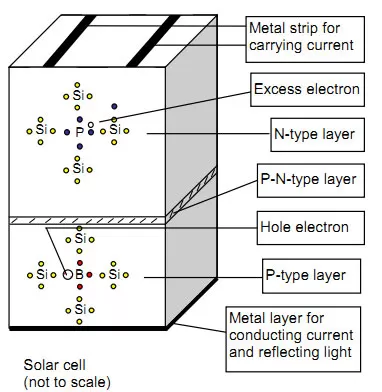
Pic 1 Schematic diagram of the PN junction of a solar cell
Under certain lighting conditions, by changing the size of the load resistance of the solar cell, the relationship between the output voltage and the output current can be measured. The output volt-ampere characteristic curve of the solar cell is shown in the figure below. The volt-ampere characteristic is an important indicator for evaluating the performance of photovoltaic cells and is also a key focus in material research.
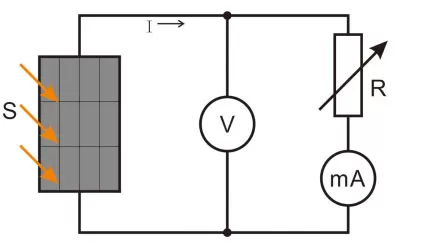

Pic 2 Solar cell I/V characteristic curve
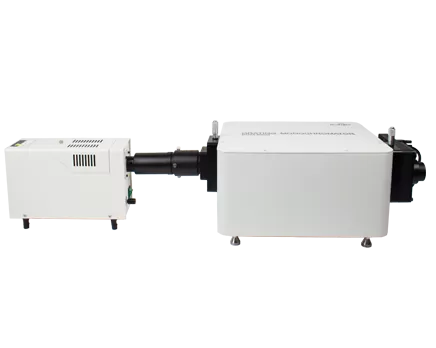
Brolight can provide comprehensive solutions for the testing and research of solar cell I/V characteristics. For instance, a high-power xenon light source combined with a solar light simulator filter for output, vacuum suction cups and probes for auxiliary testing, and the use of dedicated software to collect source meter data for I/V characteristic analysis.
Besides, BRS-8001 or BRS-8002 turnable light sources can also be used to conduct I/V characteristic tests for other new types of photonics materials. The modular product provides more options and possibilities for the expansion and extension of these applications.
 EN
EN
 jp
jp  ko
ko  fr
fr  de
de  es
es  tr
tr  ru
ru  pt
pt  ar
ar  vi
vi