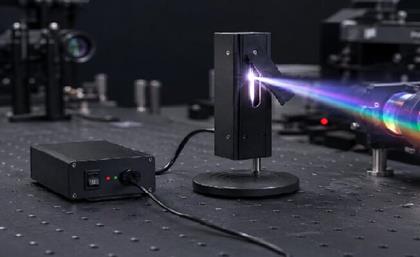
The absorbance spectrum serves as both a qualitative tool for identifying substances and a quantitative tool for measuring the concentration of molecules in a solution. Today, absorbance measurement remains the most widely used spectroscopic technique for analyzing liquids and gases, due to its simplicity, accuracy, and ease of use. Various sampling devices can be employed during testing, including cuvettes, flow cells, immersion probes, and micro cells.
Cuvette-Based Absorbance Measurement System
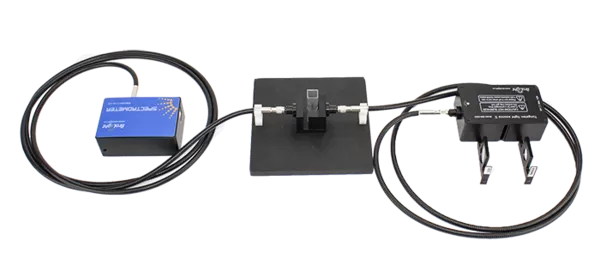
Features: Simple, accurate, and fast
Advantages: Real-time absorbance readings with reusable data; ideal for precise lab analysis
Application: Routine solution testing, calibration curve preparation, and educational or research experiments
Immersion Probe Absorbance Measurement Systems

Features: Probe immerses directly into the liquid sample, while the other ends connect to a spectrometer and light source
Advantages: Enables online solution monitoring, prevents secondary contamination, and supports in-situ measurements
Application: Process monitoring, environmental testing, and industrial fluid analysis
Core Principle: The Beer-Lambert Law
Absorbance measurements are grounded in the Beer-Lambert Law, which states that absorbance is proportional to the concentration of the absorbing species and the path length of light through the sample.
Brolight spectrometers leverage this principle to determine unknown solution concentrations by first measuring a set of standards. Compared to traditional experimental setups, Brolight systems offer greater flexibility, wider measurable ranges, and support for diverse experimental applications—both now and in the future.
Why Choose Absorbance Measurement?
High Accuracy and Reproducibility
Non-Destructive and Rapid Analysis
Broad Compatibility with various sample types and formats
User-Friendly Workflow, from calibration to results
Whether you are running routine lab tests, conducting real-time process monitoring, or exploring new research avenues, absorbance spectroscopy provides a reliable, efficient, and scalable solution.
Get Started with Brolight Spectrometers
Upgrade your lab capabilities with Brolight flexible spectrometer systems. Designed for precision and adaptability, our instruments help researchers and industry professionals push the boundaries of what's possible in spectrum analysis.
 EN
EN
 jp
jp  ko
ko  fr
fr  de
de  es
es  tr
tr  ru
ru  pt
pt  ar
ar  vi
vi