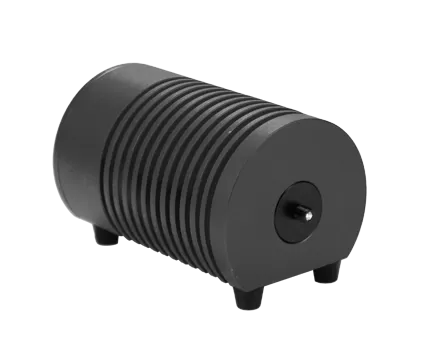
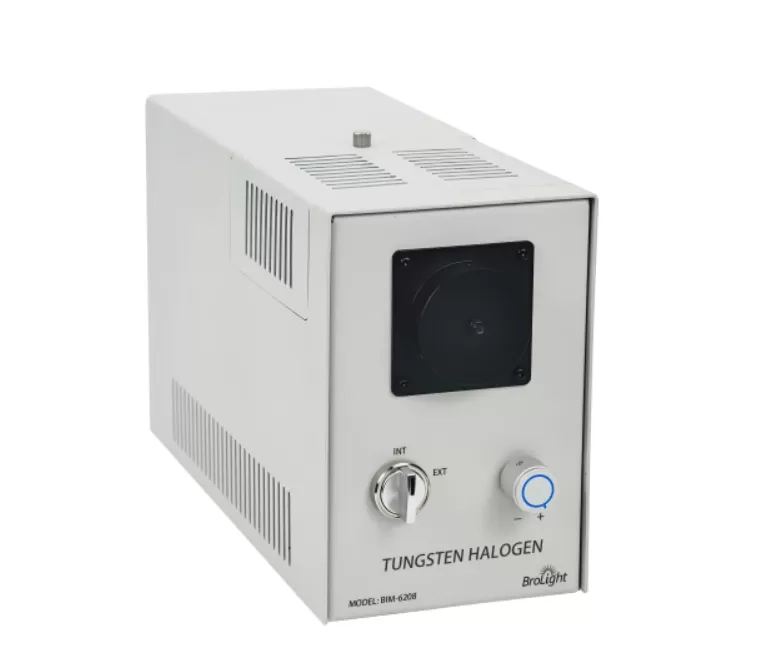
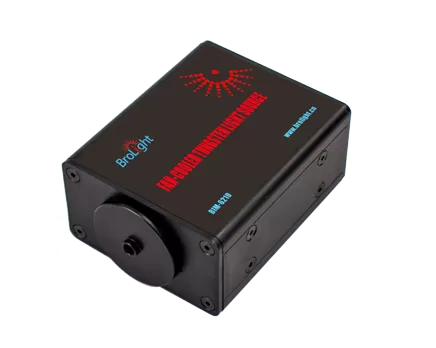
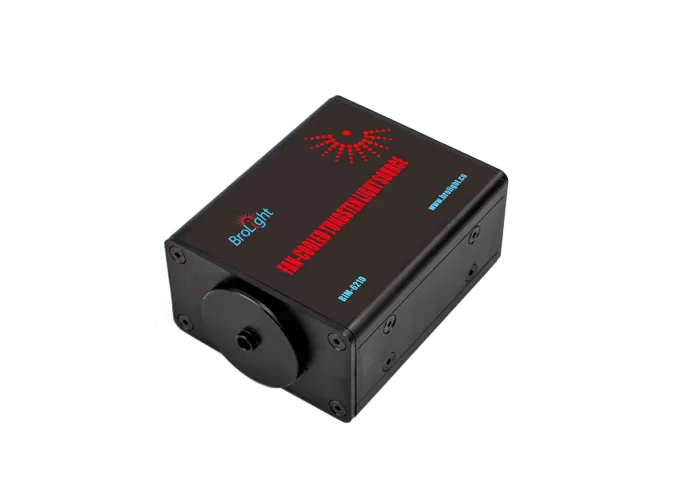
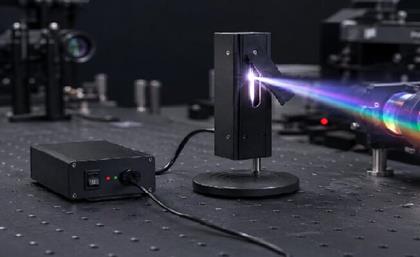
Brolight tungsten light sources are available for different spectroscopy applications, including NIR spectral analysis, absorbance measurement, reflectance testing, transmittance measurement, light source characterization and laboratory optical experiments. Users can choose a suitable model according to output intensity, cooling method, stability requirement, optical interface and measurement setup.
The Brolight tungsten light source can be used as a standard light source for spectral analysis, including material transmittance, absorbance, and reflectance measurements.
These photonics instruments integrate with spectrometers for optical characterization in research and industrial applications.
A tungsten light source works by passing electric current through a tungsten filament. As the filament heats up, it emits broadband radiation. In a tungsten halogen lamp, halogen gas inside the quartz envelope helps reduce filament material loss and supports more stable operation. The output of a tungsten halogen light source is continuous and smooth, which makes it useful for spectroscopy systems that need broadband illumination instead of a narrow single-wavelength source. Because the lamp generates heat during operation, proper cooling and stable power control are important for measurement repeatability.
When selecting a tungsten halogen light source, users should consider not only brightness but also wavelength range, output stability, cooling design, intensity control, optical interface and compatibility with spectrometers or accessories.
| Selection Factor | Why It Matters |
| Wavelength range | Determines whether the light source supports visible, VIS-NIR or NIR measurement |
| Output intensity | Affects signal strength in absorbance, reflectance and transmittance testing |
| Stability | Helps improve repeatability in spectroscopy experiments |
| Cooling method | Reduces thermal drift during long-time operation |
| Intensity adjustment | Allows users to match output power to different samples and detectors |
| Optical interface | Determines compatibility with fibers, probes, cuvette holders and spectrometers |
Best for visible and near-infrared spectroscopy, absorbance, transmittance and reflectance measurement. It provides smooth broadband output and is widely used with spectrometers.
Best for ultraviolet spectroscopy, especially below 400 nm. It is often used in UV-Vis spectroscopy and absorbance measurement.
Best for high-intensity broadband illumination, fluorescence excitation, reflectance testing and applications requiring strong pulsed or continuous light output.
Best for selected wavelength bands, compact optical systems and applications where narrow-band or controlled illumination is needed.
A tungsten light source is usually used together with a spectrometer, optical fiber, probe, sample holder or integrating sphere. Brolight can recommend complete spectroscopy setups according to the measurement method and application environment.
| Measurement Need | Suggested Configuration |
| NIR spectral analysis | Tungsten light source + NIR spectrometer + optical fiber |
| Reflectance measurement | Tungsten light source + spectrometer + reflection probe |
| Transmittance measurement | Tungsten light source + spectrometer + sample holder |
| Absorbance measurement | Tungsten light source + spectrometer + cuvette holder |
| Light source characterization | Tungsten light source + spectrometer + calibrated optical setup |
| Teaching experiment | Tungsten light source + miniature spectrometer + software |
A tungsten halogen light source is used for spectroscopy applications such as absorbance, transmittance, reflectance, NIR spectral analysis, material testing and light source characterization.