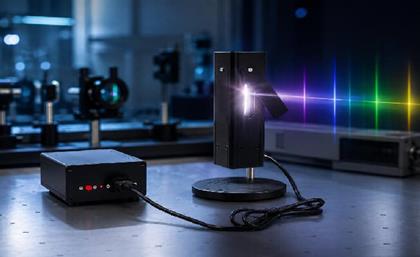
A mercury lamp is a gas discharge light source that produces ultraviolet and visible light by exciting mercury atoms inside a sealed tube. Understanding how does a mercury lamp work is important for researchers, engineers, and instrument manufacturers who use mercury light sources in spectroscopy, microscopy, calibration, and UV applications.
Unlike ordinary lamps that generate broad-spectrum light, mercury lamps create specific emission lines because excited mercury atoms release energy at fixed wavelengths. These stable spectral characteristics make mercury lamps valuable for optical measurement and scientific instruments.
Brolight provides professional optical solutions, including mercury light source products designed for spectroscopy, laboratory instruments, and industrial optical applications.
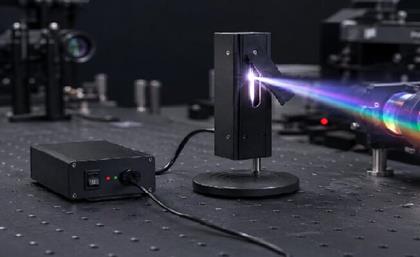
How Does a Mercury Lamp Work? Working Principle Explained
A mercury lamp works by passing an electric current through mercury vapor, causing mercury atoms to become excited and emit light at specific wavelengths.
Inside a mercury lamp, a small amount of mercury is sealed in a glass or quartz tube together with an inert starting gas. When voltage is applied between the electrodes, the gas becomes ionized and creates an electrical discharge.
This discharge transfers energy to mercury atoms, causing electrons to move to higher energy states. When these electrons return to their original energy levels, they release energy in the form of photons, producing the characteristic mercury emission spectrum.
The main working process includes:
Electrical discharge starts inside the lamp tube.
Mercury atoms are excited by electron collisions.
Excited mercury atoms release photons.
The emitted radiation forms specific UV and visible wavelength peaks.
According to the National Institute of Standards and Technology (NIST) Atomic Spectra Database, mercury has well-defined atomic emission lines that are widely used as references in optical measurements.
Mercury Lamp Spectrum and Emission Wavelength Characteristics
The mercury lamp spectrum consists of distinct ultraviolet and visible emission lines generated by mercury atomic transitions.
Mercury lamps are widely used because they provide stable spectral peaks instead of continuous radiation. Important mercury emission wavelengths include:
| Mercury Emission Line | Approximate Wavelength | Spectral Region | Applications |
|---|
| UV resonance line | 253.7 nm | Ultraviolet | UV applications, photochemical processes |
| Near UV line | 365 nm | UVA | Fluorescence, UV curing |
| Violet line | 404.7 nm | Visible | Optical calibration |
| Blue line | 435.8 nm | Visible | Spectroscopy |
| Green line | 546.1 nm | Visible | Instrument calibration |
| Yellow lines | 577–579 nm | Visible | Optical analysis |
The output spectrum depends on mercury vapor pressure, lamp structure, and operating conditions. For example, a high pressure mercury lamp generally produces stronger visible emission and higher intensity compared with low-pressure designs. The National Institute of Standards and Technology (NIST) provides measurement references that support accurate wavelength calibration and optical research.
Low Pressure Mercury Lamp vs High Pressure Mercury Lamp
Low pressure and high pressure mercury lamps use the same mercury discharge principle but produce different spectral characteristics due to different operating pressures.
| Feature | Low Pressure Mercury Lamp | High Pressure Mercury Lamp |
|---|
| Mercury Vapor Pressure | Lower | Higher |
| Main Output | Strong UV emission | Stronger visible and broader spectrum |
| Typical Wavelength | Mainly 253.7 nm | Multiple UV and visible lines |
| Light Intensity | Lower | Higher |
| Common Uses | UV sterilization, photochemical applications | Microscopy, spectroscopy, optical instruments |
A low pressure mercury lamp is often selected when strong ultraviolet output is required, while high pressure mercury lamps are preferred for applications requiring higher intensity and broader spectral coverage.
Mercury Light Source Applications in Optical Systems
A mercury light source is commonly used in optical instruments because its stable emission wavelengths provide reliable illumination and calibration performance.
Typical mercury lamp applications include:
In UV-visible analysis systems, mercury emission lines can be used to verify wavelength accuracy and instrument performance. For advanced analytical applications, Ibrolight also provides UV visible spectrometer solutions designed for precise optical measurements. Choosing the correct mercury lamp depends on required wavelength range, optical power, lifetime, and compatibility with the instrument system.
Mercury Lamp vs Other Optical Light Sources
Mercury lamps differ from other optical light sources because they provide strong characteristic emission peaks, while other lamps may provide broader spectral output.
| Light Source | Spectrum Characteristics | Common Applications |
|---|
| Mercury Lamp | Sharp UV and visible emission lines | Calibration, spectroscopy |
| Deuterium Lamp | Strong UV continuous spectrum | UV spectroscopy |
| Xenon Lamp | Broad continuous spectrum | Imaging, simulation |
| Tungsten Halogen Lamp | Visible and infrared output | General spectroscopy |
For applications requiring specific wavelength references, mercury lamps remain an important choice. However, broader-spectrum applications may require xenon or deuterium light sources depending on the measurement requirements.
Conclusion
Understanding how does a mercury lamp work helps users select the right optical light source for scientific and industrial applications. A mercury lamp generates light through electrical discharge in mercury vapor, producing stable UV and visible emission lines that are valuable for spectroscopy, calibration, microscopy, and optical analysis.
Important mercury wavelengths, such as 253.7 nm, 365 nm, 435.8 nm, and 546.1 nm, make mercury light sources suitable for applications requiring reliable spectral performance.
Brolight provides customized mercury light source solutions and optical products to support research institutions, instrument manufacturers, and industrial customers worldwide.
FAQ
How does a mercury lamp produce light?
A mercury lamp produces light when electrical discharge excites mercury atoms inside the lamp tube. The excited atoms release photons at specific wavelengths when returning to lower energy states.
What wavelengths does a mercury lamp emit?
A mercury lamp commonly emits wavelengths including 253.7 nm, 365 nm, 404.7 nm, 435.8 nm, 546.1 nm, and 577–579 nm.
What is the difference between low pressure and high pressure mercury lamps?
Low pressure mercury lamps mainly produce strong ultraviolet output, especially around 253.7 nm, while high pressure mercury lamps provide stronger intensity and broader UV-visible emission.
Why are mercury lamps used in spectroscopy?
Mercury lamps are used in spectroscopy because their stable emission lines provide reliable wavelength references for calibration and measurement.
Is a mercury lamp a UV light source?
Yes. Mercury lamps can produce strong ultraviolet radiation, especially low-pressure mercury lamps with significant 253.7 nm output.
Does Ibrolight provide customized mercury light sources?
Yes. Brolight provides mercury light sources and customized optical solutions for spectroscopy, scientific instruments, and industrial applications.
 EN
EN
 jp
jp  ko
ko  fr
fr  de
de  es
es  tr
tr  ru
ru  pt
pt  ar
ar  vi
vi