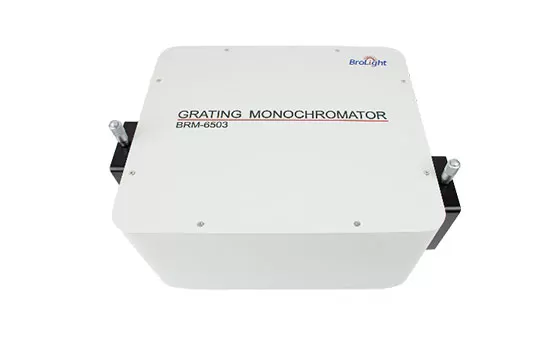
Grating Monochromator Essence: Wavelength Selector, Not Just a Spectrometer
Many users, when first encountering a monochromator, tend to equate it with a "spectrometer" (an instrument that analyzes which wavelengths are present in light). In reality, the core function of the BRM-650X is the reverse operation: it can precisely "slice" out the exact wavelength you need from a broadband light source (such as a xenon or halogen lamp).
Therefore, it has two major roles:
Role A (Output Application): As a tunable monochromatic light source – "I need pure light of a specific wavelength for my experiment" (e.g., calibrating detectors, photochemical excitation).
Role B (Input Application): As a spectral receiver – "I need to analyze which wavelengths are present in the light emitted by my sample" (e.g., measuring fluorescence, LED spectra).
Core Concept: Blaze Wavelength – The Key Parameter Determining "How Bright" You Get
What is Blaze Wavelength?
The core component of a grating monochromator is the diffraction grating. There is an angle between the grooved surface of the grating and the grating plane, known as the "blaze angle". This angle determines at which wavelength the grating has the highest diffraction efficiency (typically 60-80%), and this wavelength is the blaze wavelength.
Why is Blaze Wavelength So Important?
Near the blaze wavelength, the monochromator outputs the strongest light; the farther you deviate from the blaze wavelength, the more the output intensity attenuates. For example, for a grating blazed at 500nm, the output efficiency is highest at 500nm, but may drop to 20% or even lower at 300nm or 800nm.
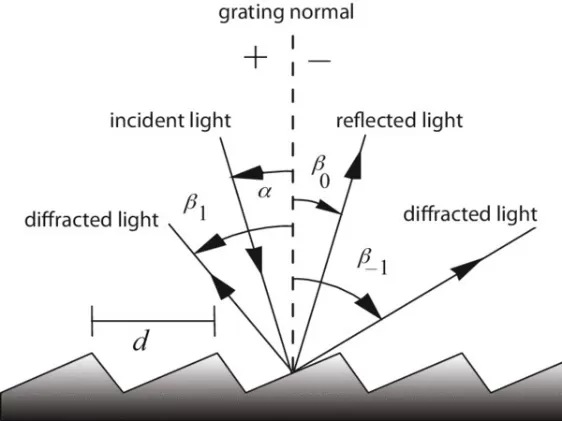
Easy Understanding: Think of a grating as an "eccentric mirror" that works "most diligently" at a specific wavelength. If the wavelength you need happens to be the blaze wavelength, you will get the brightest light. If you need light far from the blaze wavelength, the output may be very weak or even unusable.
How to Choose the Blaze Wavelength?
Golden Rule of Selection:
Make your most commonly used or most important wavelength as close as possible to the grating's blaze wavelength.
Your Core Working Wavelength Range | Recommended Blaze Wavelength | Recommended Model |
Ultraviolet (250-400nm) | 300nm (custom) | Custom model |
Visible (400-700nm) | 500nm | BRM-6501 |
Covering both visible and NIR (400-1000nm) | 500nm + 800nm (dual-blaze) | BRM-6502 |
Near-infrared (800-1600nm) | 800nm or 1000nm (custom) | Custom model |
Blaze Wavelength Configurations of BRM-650X:
Model | Grating Configuration | Blaze Wavelength | Optimal Efficiency Range | Application Scenario |
BRM-6501 | 1200 lines, single-blaze | 500nm | 400-600nm | Routine visible range applications |
BRM-6502 | 1200 lines, dual-blaze | 500nm + 800nm | 400-600nm and 700-900nm | Need efficiency in both visible and NIR |
BRM-6503 | 1200 lines + 600 lines | 500nm(1200L)+800nm(1200L)+ 1800nm(600L) | 400-600nm,700-900nm and 1700-1900nm | Ultra-broad spectrum, covering up to 2200nm |
Key Tip: If your working wavelength is concentrated in a specific Wavelength Range, we recommend contacting us to discuss a custom grating with the corresponding blaze wavelength for optimal output intensity.
How to Select Grating Monochromator Based on Your "Role"?
Your Core Need | Role | Key Selection Parameters | Recommended Configuration Strategy |
I need pure light of a specific wavelength | Tunable Light Source | ① Blaze wavelength (determines peak efficiency) | Keep your common wavelength near the blaze wavelength; pair with a high-brightness light source; choose an appropriate slit width. |
② Optical throughput (brightness) |
③ Bandwidth (purity) |
I want to know which wavelengths are in the light | Spectrum Analyzer | ① Wavelength accuracy | Focus on groove density; pair with a high-sensitivity detector (CCD, PMT). |
② Resolution |
③ Stray light rejection |
How to Choose Grating Monochromator Among the Three Standard Models?
Model | Wavelength Range(nm) | Blaze Configuration | Application Scenario | Suggestion |
BRM-6501 | 200-1100 | 500nm (single-blaze) | Routine UV-Vis applications | Preferred for daily work in the 450-650nm Wavelength Range. |
BRM-6502 | 200-1100 | 500nm+800nm (dual-blaze) | Need efficiency in both visible and NIR | Ideal for cross-Range work without frequent grating changes. |
BRM-6503 | 200-2200 | 500nm (1200L) + 800nm (1200L) + 1800nm (600L) | Ultra-broad spectrum, covering NIR up to 2200nm | Suitable for NIR detection and wide spectral scanning. |
Quick Selection Guide for Grating Monochromator Buyers:
Need only visible light (e.g., 532nm, 633nm) → BRM-6501
Need both visible and NIR (e.g., scanning from 500nm to 1000nm) → BRM-6502 (dual-blaze ensures efficiency at both ends)
Need coverage up to 2200nm (e.g., photodetector QE testing into NIR) → BRM-6503
Desired operating wavelength is in the UV (300-400nm) or deep NIR (e.g., 1064nm) → Recommend a custom blaze wavelength
Typical Application Scenarios of Grating Monochromator
Scenario 1: Photodetector Quantum Efficiency (QE) Calibration (Light Source Role)
Operation: The monochromator sequentially outputs monochromatic light at different wavelengths to illuminate the detector under test.
Goal: Measure the detector's responsivity at each wavelength.
Key Selection Point: Ensure the wavelength range of interest covers the high-efficiency zone of the grating. For measuring a wide Range like 400-1100nm, consider the BRM-6502 (dual-blaze) or a custom multi-grating turret.
Scenario 2: Specific Range Irradiation for Photochemistry / Photobiology (Light Source Role)
Operation: Extract narrowband light at 313nm (UVB) or 365nm (UVA) from a broadband source.
Goal: Eliminate interference from other wavelengths to study the effect of a single wavelength on a sample.
Key Selection Point: For 365nm operation, the standard 500nm-blazed grating has low efficiency here. A custom grating blazed in the 300-400nm range is recommended for sufficient irradiance.
Summary
To select a monochromator, first choose the blaze wavelength. Make your most commonly used wavelength as close as possible to the grating's blaze wavelength for the brightest output. The BRM-650X offers standard blaze wavelengths at 500nm, 800nm, and 1000nm. For specific needs, customizing the blaze wavelength is key to optimal performance.
 EN
EN
 jp
jp  ko
ko  fr
fr  de
de  es
es  tr
tr  ru
ru  pt
pt  ar
ar  vi
vi