The application of UV visible spectrometer technology covers chemical analysis, concentration measurement, water quality testing, biological research, materials characterization and industrial quality control. A UV-Vis spectrometer measures how much ultraviolet and visible light is absorbed, transmitted or reflected by a sample across selected wavelengths.
For laboratories, universities, analytical instrument builders and industrial testing teams, UV-Vis spectroscopy is valuable because it is fast, relatively simple, non-destructive for many samples and suitable for both qualitative and quantitative measurement. Brolight provides UV-Vis Spectrometer, Miniature Spectrometer and light source solutions for compact optical analysis, OEM integration and laboratory measurement.
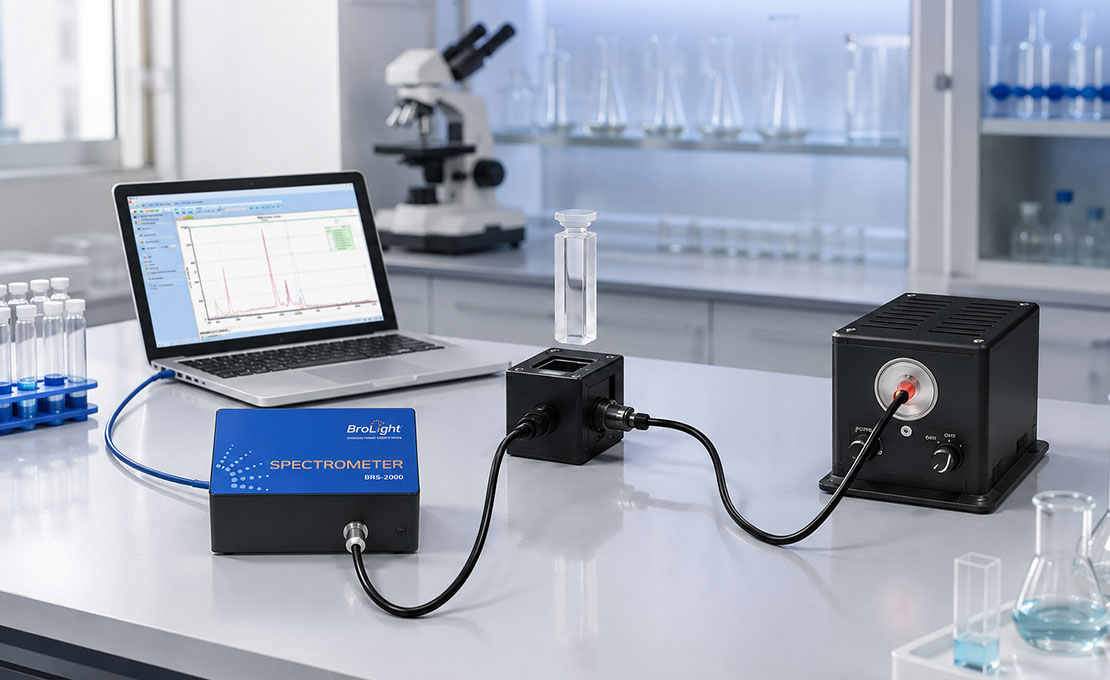
What Is a UV Visible Spectrometer Used For?
A UV visible spectrometer is used to measure light absorption or transmission in the ultraviolet and visible wavelength regions to identify or quantify substances. In most UV-Vis applications, the sample absorbs specific wavelengths based on molecular structure, concentration and optical path length.
The ultraviolet region is commonly defined as 100–400nm, while visible light is approximately 400–700nm. Many UV-Vis systems cover a practical measurement range such as 190–1100nm when paired with suitable light sources. Brolight notes that deuterium lamps are often used for the UV region from about 190–400nm, while tungsten-halogen light sources are commonly used for the visible and near-infrared region.
UV-Vis analysis is often based on absorbance and transmittance. NIST describes spectrophotometric techniques as methods used to measure optical properties such as reflectance, transmittance, absorbance, emittance and fluorescence. This makes UV-Vis spectrometers useful not only for liquid samples, but also for films, coatings, glass, optical filters and material surfaces.
Main Applications of UV Visible Spectrometers
Main applications of UV visible spectrometers include concentration analysis, reaction monitoring, water testing, biomolecule measurement, optical material testing and quality control. These applications are common because UV-Vis data can provide rapid information about how a sample interacts with light.
In chemistry and biochemistry, UV-Vis spectrometers are used to quantify compounds, monitor reaction progress and compare absorption peaks. In life science, they can support protein and nucleic acid analysis, especially around commonly used wavelengths such as 260nm and 280nm. In environmental testing, UV-Vis instruments can help monitor organic matter, nitrate, color and water quality indicators.
For water applications, a peer-reviewed review of online UV-Vis spectrophotometer for drinking water quality reports that UV-Vis instruments can measure parameters such as UV absorbance at 254nm and support direct water quality monitoring through built-in algorithms. For industrial buyers, this shows why UV-Vis spectroscopy is practical for both laboratory testing and process monitoring.
Brolight’s UV-Vis spectrometer products are designed for identifying and quantifying compounds in chemistry, biochemistry and applied research. For compact instruments and OEM systems, Brolight’s miniature spectrometers use a compact optical-mechanical platform and support absorption, transmission, fluorescence, LED characterization, solar spectrum testing and laser spectrum analysis.
UV-Vis Spectrometer Application Comparison Table
A UV visible spectrometer application should be matched with wavelength range, light source, sample type and required resolution. The table below helps buyers compare typical use cases.
| Application Area | Typical Measurement | Common Wavelength Focus | Suitable Brolight Solution |
| Chemical Analysis | Absorbance and concentration | 190–800nm | UV-Vis spectrometer with deuterium/tungsten source |
| Life Science | DNA, RNA and protein absorbance | 260nm, 280nm | Compact UV-Vis spectrometer |
| Water Quality | UV254, nitrate, color and organics | 200–600nm | UV-Vis system with stable UV light source |
| Optical Materials | Transmittance, reflectance, absorbance | UV-VIS-NIR depending on material | Miniature or high-resolution spectrometer |
| Industrial QC | Color, coating, film and product consistency | 400–700nm or wider | Miniature spectrometer for production integration |
| Photonics Testing | LEDs, filters, light sources and lasers | Product-specific wavelengths | High-resolution spectrometer and optical power tools |
For higher spectral detail, Brolight’s High Resolution Spectrometer achieves optical resolution up to 0.08nm across UV-VIS-NIR ranges, making it suitable for laser characterization, emission spectra and absorption analysis where closely spaced spectral features must be distinguished.
How to Choose a UV Visible Spectrometer for Your Application
Choosing a UV visible spectrometer means matching wavelength range, optical resolution, detector sensitivity, light source stability, sample interface and software functions to the real measurement task. A system for classroom absorbance testing does not need the same specification as a production-line optical inspection system.
For absorbance and concentration measurement, buyers should focus on wavelength accuracy, stray light, photometric repeatability and stable illumination. For optical filters or coatings, reflectance and transmittance accessories may be required. For OEM devices, compact size, USB interface, SDK support, optical fiber connection and long-term supply stability can be more important than benchtop appearance.
Light source selection is also critical. A Deuterium Light Source is suitable for stable UV output, while tungsten, xenon, mercury or LED sources may be selected for different spectral ranges and intensity needs. For UV-Vis absorbance, the Beer-Lambert relationship is often used to connect absorbance with concentration. The peer-reviewed article The Bouguer-Beer-Lambert Law describes this law as one of the most important laws in optical spectroscopy.
Brolight can support users in selecting spectrometers, light sources, optical fibers, cuvette holders and software according to application requirements. Buyers should prepare wavelength range, sample type, absorbance level, required resolution, integration space, testing speed and communication interface before requesting a solution.
Conclusion
UV visible spectrometers are widely used because they provide fast and useful optical information from UV and visible light interaction with samples. Their applications include chemical concentration analysis, biological measurement, drinking water monitoring, materials testing, optical coating inspection, LED characterization and industrial quality control.
For buyers, the right UV-Vis spectrometer should be selected by application rather than by one specification alone. Wavelength range, optical resolution, light source stability, sample holder, software and OEM integration all affect real performance. Brolight provides UV-Vis spectrometers, miniature spectrometers, high-resolution spectrometers and stable light sources to support research, education, industrial testing and analytical instrument development.
FAQ
1. What is the main application of a UV visible spectrometer?
The main application is measuring how samples absorb or transmit UV and visible light, which helps identify compounds, quantify concentration and evaluate optical properties.
2. What wavelength range does UV-Vis spectroscopy use?
UV-Vis spectroscopy commonly uses ultraviolet wavelengths from about 100–400nm and visible wavelengths from about 400–700nm, while many practical instruments may cover around 190–1100nm.
3. Can UV-Vis spectrometers be used for water quality testing?
Yes. UV-Vis spectrometers can be used for water quality indicators such as UV254 absorbance, nitrate, color and organic matter monitoring, depending on method and calibration.
4. What light source is used for UV-Vis spectroscopy?
Deuterium lamps are commonly used for UV wavelengths, while tungsten-halogen lamps are commonly used for visible and near-infrared wavelengths. Xenon lamps can also provide broad-spectrum output.
5. What is the difference between a UV-Vis spectrometer and a NIR spectrometer?
A UV-Vis spectrometer measures ultraviolet and visible light absorption or transmission, while a NIR spectrometer measures near-infrared wavelengths, typically used for different molecular and material analysis.
6. Why choose Brolight UV-Vis spectrometers?
Brolight provides UV-Vis spectrometers, miniature spectrometers, high-resolution spectrometers and stable light sources for chemistry, biochemistry, water analysis, material testing, education and OEM optical systems.
 EN
EN
 jp
jp  ko
ko  fr
fr  de
de  es
es  tr
tr  ru
ru  pt
pt  ar
ar  vi
vi