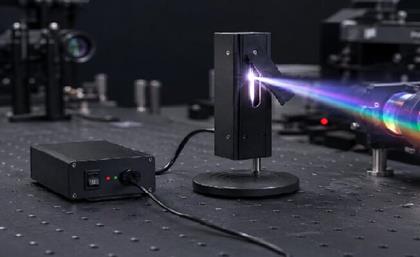
A Raman spectrometer is a scientific instrument used to identify molecular structures by analyzing scattered light. It provides the chemical fingerprint of materials. This non-destructive testing method aids research, quality control, and forensic analysis across multiple fields. From a complex instrument to an indispensable tool, the journey begins with understanding its core principles. Let's dissect how this technology works and its significance.
Understanding the Basics: What is Raman Spectroscopy and How Does It Work?
Confused about the physical principles of Raman spectroscopy? You're not alone. The theory can seem abstract. Let's simplify it into clear and understandable concepts. Raman spectroscopy works by illuminating a sample with a laser. Most of the light scatters with the same energy, but a tiny fraction scatters with different energy. This "Raman Shift" reveals the molecular vibrations and chemical properties of the sample.
Core Components and Workflow
To understand how a Raman spectrometer operates, we need to look at its main components and step-by-step process. At Bioer Technology, we design systems based on these fundamental building blocks.
| Component | Function | Simple Analogy |
| Laser Source | Provides a single pure color of light to probe the sample | A very precise, powerful flashlight |
| Sample Interface | Transmits laser to the sample and collects the scattered light | Lens that focuses light and captures reflections |
| Spectrometer | Separates collected light into different colors (wavelengths) | A precise prism that disperses light into a rainbow |
| Detector | Measures the intensity of each color in the scattered light | A high-sensitivity camera capturing the rainbow image |
The process starts with illuminating the sample with a laser. Imagine the molecules as tiny vibrating spheres. The laser interacts with these vibrations. Most interactions are "elastic," meaning the light reflects back with the same color, known as Rayleigh scattering. However, a very few interactions are "inelastic." In these cases, the molecules gain or lose a small amount of energy from the collision, changing the color of the scattered light, which is the Raman effect. The spectrometer and detector work together to measure these slight color changes. They generate a chart called a spectrum, which is like a unique molecular fingerprint. Each peak in the spectrum corresponds to a specific type of chemical bond. By analyzing these peaks, we can identify unknown substances, check material purity, or study molecular structures. The entire process is quick and, most importantly, non-destructive to the sample.
Cross-Industry Applications: Where is Raman Spectroscopy Used Today?
Think Raman spectroscopy is for high-end laboratories only? Many people do. This perception limits its potential. In reality, its applications in everyday science and industry are broad and growing. Raman spectroscopy is used in pharmaceutical drug development, security explosives detection, and semiconductor analysis in materials science. Its non-destructive nature makes it extremely versatile.
From the Lab to the Real World
The true power of Raman spectroscopy lies in its adaptability. Its non-destructive nature and minimal sample preparation requirements enable it to tackle real-world problems beyond the lab. At Bioer Technology, we see the devices applied in various innovative fields.
| Industry | Application | Key Advantage |
| Pharmaceuticals | Verify raw material identity and inspect final product quality | Ensures drug safety and efficacy without damaging precious samples |
| Materials Science | Characterize carbon nanotubes and study semiconductor stress | Provides detailed molecular information for new materials development |
| Forensic Science | Identify unknown powders, analyze drug evidence, and examine trace evidence | Provides decisive chemical analysis for minute samples |
| Life Sciences | Study cellular processes and diagnose diseases at the molecular level | Enables live cell imaging and biological discoveries |
In the pharmaceutical industry, for example, quality control technicians can use a Raman spectrometer to confirm whether powdered raw materials are the correct active ingredients. They just point the probe at the sample and get results in seconds. For security personnel, handheld Raman devices can screen for hazardous chemicals and explosives in airports or public venues. The ability to quickly and safely obtain definitive chemical answers is revolutionizing these industries. The biggest trend is the application moving from central laboratories to the frontline.
How to Choose the Right System: Handheld vs. Benchtop and Future Trends?
Unsure whether to choose a handheld or benchtop Raman system? This is a common dilemma for many customers. The choice entirely depends on your specific needs for mobility and precision. Choose a benchtop spectrometer for lab research requiring precise analysis. Opt for a handheld device for on-site, instant detection, such as material identification or security screening. The right tool depends on the specific application scenario.
Matching the Tool to the Task
Choosing a Raman system isn't about finding the "best" one but the one that best suits your work. The core decision often balances the analytical power of benchtop equipment with the portability of handheld devices. Let's compare their key features.
| Feature | Benchtop Spectrometer | Handheld Spectrometer |
| Performance | High resolution and sensitivity for complex samples | Suitable for most common materials, limited by smaller optical system |
| Portability | Stationary, requires a lab bench and power outlet | Highly portable, battery-operated, usable anywhere |
| Ease of Use | Operation and data analysis may require expertise | Designed for non-experts, one-button operation, easy to use |
| Typical Use Case | Detailed research, method development, complex mixtures analysis | Rapid material identification, field testing, quality control on production lines |
| Cost | Higher initial investment | Usually more affordable |
Benchtop systems are the workhorses of research laboratories. They provide the highest spectral resolution and sensitivity. If your work involves analyzing complex mixtures, developing new analytical methods, or requiring the highest data quality, you should go with a benchtop system. For instance, in a university lab researching new polymer blends, such a system is indispensable. On the other hand, handheld systems bring the lab to the sample site. Their greatest advantage is mobility. Imagine geologists identifying minerals at an outcrop or customs officers screening shipments at a dock — in these scenarios, benchtop systems are impractical. Handheld devices are rugged, user-friendly, and deliver answers in seconds. Looking to the future, Raman spectroscopy developments are focusing on integration and accessibility. We at Bioer Technology are working to make these systems smaller, smarter, and more connected. Trends include using artificial intelligence to automatically interpret spectra and developing low-cost modular systems for educational and routine industrial use. The goal is to make this powerful analytical technology accessible to everyone, from high school students to factory operators.
Conclusion
Raman spectrometers are powerful tools for non-destructive material identification. Understanding their basic principles, application scenarios, and system selection methods can unlock their immense potential in both scientific and industrial fields.
 EN
EN
 jp
jp  ko
ko  fr
fr  de
de  es
es  tr
tr  ru
ru  pt
pt  ar
ar  vi
vi