Product Essence: High-Quality Coherent Excitation Source
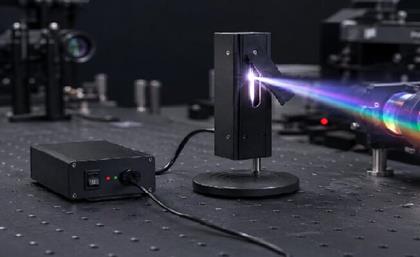
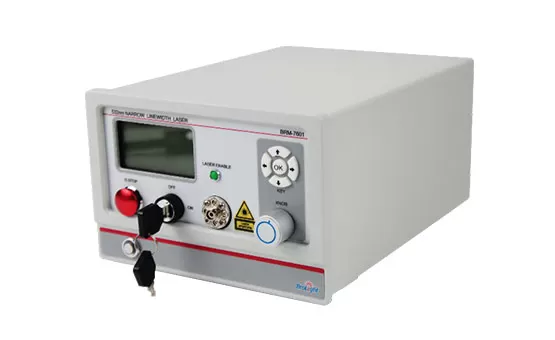
The core characteristic of the BRM-760X series narrow linewidth laser is “purity” – linewidth < 0.1nm, power stability ±2%, and built-in TEC temperature control for stable output. It provides single-wavelength, narrow-linewidth, highly stable coherent light, primarily used for exciting samples to generate Raman scattering, fluorescence, and other signals, rather than for direct measurement.
How to Select: Starting from “What Sample Will You Measure?”
The first principle of selection: Lasers of different wavelengths behave completely differently in samples. The wavelength determines penetration depth, fluorescence interference level, and Raman signal intensity.
Wavelength (nm) | Output Power (mW) | Suitable Scenarios | Suggestion |
532 | 0-100 | Inorganic materials, carbon materials, Raman resonance experiments | The classic choice for testing carbon materials like graphene, carbon nanotubes. |
785 | 0-400 | Chemicals, organic materials, biological samples | Extremely low fluorescence interference; the most common choice in chemistry/biology. |
830 | 0-400 | Dark/colored samples, heat-sensitive samples | Lower photodamage than 785nm, suitable for live samples. |
1064 | 0-800 | Heat-sensitive samples, deep penetration needs | Minimal fluorescence interference, but Raman signals are weaker. |
Standard Wavelengths & Customization Service:
The BRM-760X series standard products offer four commonly used wavelengths: 532nm, 785nm, 830nm, and 1064nm, covering the main Raman application bands from visible to near-infrared. If you require other specific wavelengths (such as 488nm, 638nm, 670nm, 980nm, etc.), we support wavelength customization services. Please contact our sales team to discuss your specific requirements, and we will provide a tailored solution.
Quick Selection Guide:
Inorganic materials, carbon materials → 532nm
Organic materials, pharmaceuticals, biological tissues → 785nm (preferred) or 830nm
Dark samples or live specimens → 830nm or 1064nm
Other special wavelength requirements → Contact us for customization
Need External Modulation?
The BRM-760X supports 5V TTL / 5V Analogue external modulation.
Building a Complete Raman Spectroscopy System: Modular Configuration
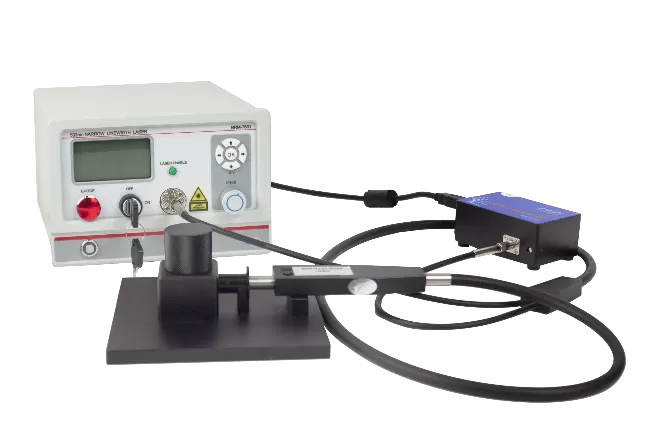
The BRM-760X narrow linewidth laser is the core excitation source for a Raman system. To meet the flexibility needs of research and product prototyping, Brolight offers Raman spectrometers and Raman fiber optic probes. Users can freely combine modules based on their application to build a complete Raman measurement chain.
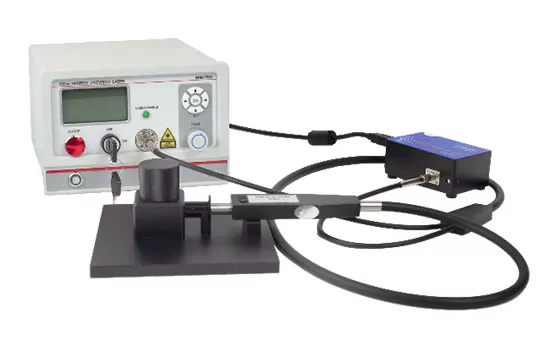
Typical Raman System Components:
Module | Product Series | Function | Key Selection Points |
Excitation Source | BRM-760X Narrow Linewidth Laser | Provides monochromatic excitation light | Choose standard wavelength or customize a special wavelength. |
Raman Probe | SIM-6131 Series | Transmits excitation light and collects Raman signal | Must match laser wavelength; built-in OD6 filter removes Rayleigh signal. |
Spectrometer | Miniature Spectrometer Series | Disperses and detects Raman spectrum | ① Choose range/resolution based on Raman shift. |
② Choose sensitivity based on signal intensity – weak signal samples (low concentration, low Raman cross-section) need high-sensitivity spectrometers. |
Sample Holder | Solid/Liquid/Powder Holders | Adapt to different sample forms | Choose based on sample form. |
Note on Spectrometer Sensitivity:
Raman scattering signals are inherently very weak (typically 10⁻⁶ to 10⁻⁸ of the excitation intensity). For low-concentration samples, weakly scattering materials (e.g., some biological tissues, transparent crystals), or fast imaging needs, spectrometer sensitivity directly determines whether a signal can be detected. Brolight offers high-sensitivity Miniature Spectrometers optimized for weak signal applications, achieving higher signal-to-noise ratios under the same excitation conditions.
Key Specifications of SIM-6131 Series Raman Probe:
Center Wavelength | Spectral Range (Raman Shift) | Working Distance | OD | Fiber Connector |
532nm | 176-4000 cm⁻¹ | 7.5mm | OD6 | FC/PC or SMA905 |
785nm | 176-3500 cm⁻¹ | 7.5mm | OD6 | FC/PC or SMA905 |
830nm | 176-2800 cm⁻¹ | 7.5mm | OD6 | FC/PC or SMA905 |
1064nm | 200-3000 cm⁻¹ | 7.5mm | OD6 | FC/PC or SMA905 |
Modular Advantage: Research and product development often require flexible experimental setups. Brolight’s Raman system uses a modular design – laser, probe, and spectrometer can be selected and replaced independently. Whether building a lab research platform or conducting prototype validation and functional testing for new products, you can find the right configuration to quickly validate technical approaches and reduce upfront investment costs.
Typical Application Scenarios
Scenario 1: Raman Spectroscopy Analysis (Core Application)
Raman spectroscopy is a molecular fingerprint technique. The laser excites the sample, generating Raman scattering. Analyzing the scattered spectrum can non-destructively identify material composition.
Practical Tips for Wavelength Selection:
785nm is the most widely used in chemistry, pharmaceuticals, and materials due to low fluorescence.
532nm suits inorganic materials and carbon materials, but biological samples can show strong fluorescence.
1064nm has the lowest fluorescence interference, but signal strength is inversely proportional to the fourth power of the wavelength.
Scenario 2: Flow Cytometry
Lasers excite fluorescent markers on cells. Narrow linewidth reduces spectral overlap, improving detection specificity.
Scenario 3: Confocal Microscopy
As an excitation source for confocal microscopy, 532nm is suitable for GFP and other green fluorescent proteins, while 785nm/830nm suits near-infrared dyes for multiphoton imaging.
Summary
When you need a “pure, stable, and wavelength-accurate” excitation light for Raman spectroscopy or fluorescence imaging, the BRM-760X is your ideal light source. Standard wavelengths are 532/785/830/1064nm, and other wavelengths are available upon request. Choose the most appropriate wavelength based on your sample’s fluorescence characteristics and penetration depth requirements.
Modular Setup Reminder: Brolight offers SIM-6131 Raman probes and Miniature Spectrometers optimized for resolution and sensitivity that match the BRM-760X series. These can be flexibly configured into a complete Raman measurement system, meeting the diverse needs of lab research and product development prototyping.
 EN
EN
 jp
jp  ko
ko  fr
fr  de
de  es
es  tr
tr  ru
ru  pt
pt  ar
ar  vi
vi