A deuterium lamp emission spectrum is the ultraviolet light output produced by a deuterium gas-discharge lamp, commonly used as a stable UV source in UV-Vis spectroscopy. Because many molecules absorb strongly in the ultraviolet region, deuterium lamps are widely used for absorbance, transmittance, concentration measurement, water analysis, HPLC detection and optical material testing.
For laboratories and instrument builders, the value of a deuterium lamp is not only brightness. The real performance depends on spectral range, output smoothness, stability, stray peaks, lamp lifetime, window material, thermal control and matching with the spectrometer. Brolight provides Deuterium Light Source solutions for high-precision absorbance, transmittance and reflectance measurements.
What Is a Deuterium Lamp Emission Spectrum?
A deuterium lamp emission spectrum is the distribution of UV light intensity emitted by excited deuterium gas across different wavelengths. In UV-Vis spectroscopy, it is valued because it provides a continuous UV output that supports scanning across many wavelengths instead of only measuring one fixed line.
Ultraviolet radiation is commonly defined as 100–400 nm by the World Health Organization’s guide to ultraviolet radiation. In practical UV-Vis instruments, deuterium lamps are often used around 190–400 nm, where tungsten-halogen lamps are weaker. This makes D₂ lamps important for measuring compounds with UV absorption bands, such as organic molecules, proteins, nucleic acids and water-quality indicators.
A deuterium lamp is different from a mercury lamp. Mercury lamps provide strong discrete spectral lines, while deuterium lamps are mainly used for continuous UV background output. This continuous output allows the spectrometer to select wavelengths using a monochromator, grating or detector array.
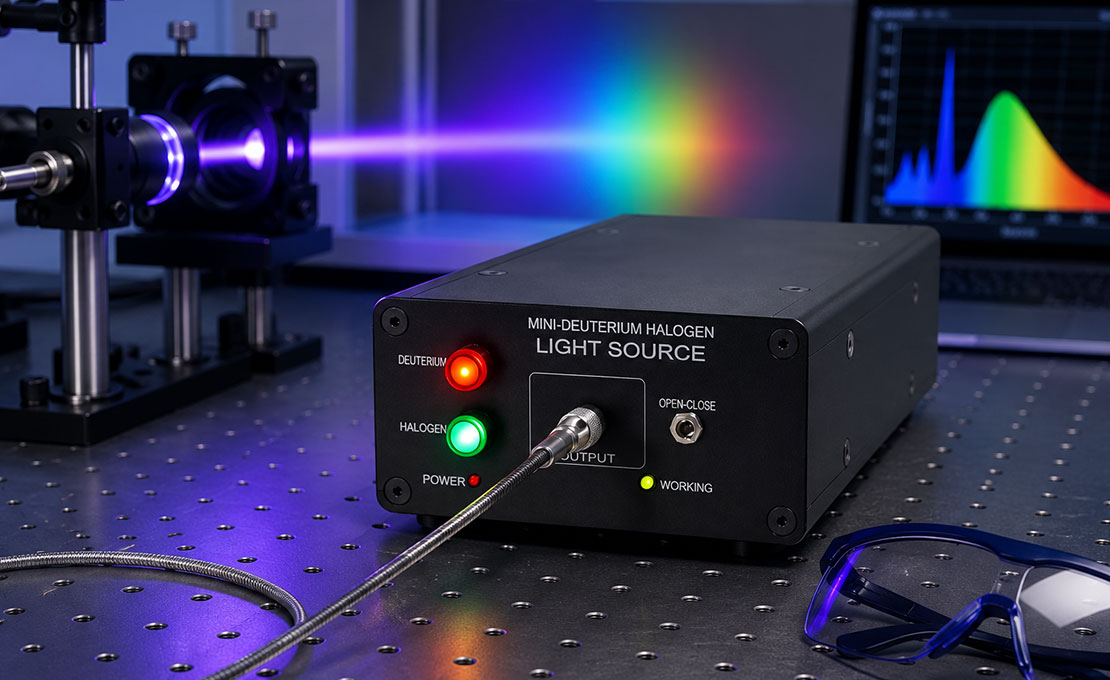
How Does a Deuterium Lamp Work in UV-Vis Spectroscopy?
A deuterium lamp works by exciting deuterium gas inside a sealed lamp, producing ultraviolet radiation as the gas discharge emits energy. The lamp output is guided through optics, passes through or reflects from the sample, and is then measured by the spectrometer detector.
In a UV-Vis system, the deuterium lamp usually covers the UV region, while a tungsten lamp covers visible and near-infrared wavelengths. Brolight’s deuterium tungsten light source integrates a deuterium lamp and a tungsten lamp, with independent control of both channels and stable broadband output. Its optical filtering design helps suppress characteristic emission peaks and deliver a smoother spectrum across 230–2500 nm.
NIST’s technical document on the deuterium lamp notes that the deuterium lamp spectrum includes a continuum with superimposed line structures in some regions. For high-precision spectroscopy, this is why output smoothing, stray peak suppression and source stability are important.
Deuterium Lamp vs Other Spectroscopy Light Sources
Deuterium lamp selection should be compared with tungsten, xenon, mercury and LED sources according to wavelength range, spectral shape, stability and application. The table below gives a practical comparison for UV-Vis buyers.
| Light Source | Main Spectral Feature | Typical Use | Buyer Consideration |
|---|
| Deuterium Lamp | Continuous UV output, often around 190–400 nm | UV absorbance, UV-Vis spectroscopy, HPLC UV detection | Strong UV intensity and stability |
| Tungsten-Halogen Lamp | Broad visible to NIR output | Visible/NIR spectroscopy, color and transmittance testing | Better for visible and NIR than deep UV |
| Deuterium + Tungsten Source | Combined UV-VIS-NIR coverage | Full-range UV-Vis-NIR absorbance and transmittance | Useful for 230–2500 nm broadband systems |
| Mercury Lamp | Strong discrete spectral lines | Calibration, fluorescence, UV curing | Not ideal for smooth broadband scanning |
| Xenon Lamp | Broad high-intensity output | Fluorescence, reflectance, pulsed applications | Higher intensity but may require more control |
| LED Source | Narrow or selected wavelength output | Dedicated wavelength testing and compact devices | Good for fixed wavelengths, not full UV scanning |
For full UV-Vis testing, a combined deuterium-tungsten system is often preferred. Brolight’s UV-Vis Spectrometer can be matched with suitable light sources for identifying and quantifying compounds in chemistry, biochemistry and applied research. Brolight’s Tungsten Light Source can support visible and NIR measurement needs when UV coverage alone is not enough.
Why the Deuterium Lamp Spectrum Matters for Measurement Accuracy
The deuterium lamp spectrum matters because UV-Vis spectroscopy depends on stable light intensity at the wavelengths being measured. If lamp output drifts, contains strong unwanted peaks or lacks enough intensity at short UV wavelengths, absorbance and concentration results may become less reliable.
In absorbance testing, the instrument compares light before and after passing through a sample. The peer-reviewed discussion of the Bouguer-Beer-Lambert Law explains the relationship between light absorption and material concentration. In practical terms, this means stable source intensity and proper calibration are essential for quantitative UV-Vis measurements.
For example, DNA and RNA analysis often uses absorption near 260 nm, while protein analysis commonly uses 280 nm. Water analysis may use UV254 absorbance to evaluate organic matter. These wavelengths sit within the UV region where deuterium lamp output is especially valuable. For instrument developers, source stability, warm-up behavior, shutter control and lamp replacement design all affect long-term performance.
Brolight’s deuterium light source supports dual-channel control, tunable tungsten lamp power, integrated shutter with TTL control and broadband spectral output. These features are useful for automated measurements, OEM instruments and research setups that need repeatable UV-Vis data.
How to Choose a Deuterium Lamp Light Source
Choosing a deuterium lamp light source means matching spectral range, output stability, smoothness, control interface, optical coupling and application requirements. A basic UV source may work for education, but quantitative spectroscopy needs better stability and optical control.
For absorbance measurement, prioritize smooth UV output, low stray light, stable intensity and compatibility with cuvettes or fiber-coupled setups. For transmittance and reflectance, check whether the source can support the required optical path and sample geometry. For OEM systems, compact size, shutter control, TTL synchronization, lamp replacement and long-term supply stability are important.
Brolight’s Miniature Spectrometer can be integrated with deuterium or deuterium-tungsten light sources for compact optical measurement systems. Buyers should prepare wavelength range, required resolution, sample type, measurement mode, fiber interface, software needs and stability requirements before selecting a lamp source.
Conclusion
A deuterium lamp emission spectrum provides continuous ultraviolet output that is essential for many UV-Vis spectroscopy applications. It is especially useful in the 190–400 nm UV region, where many chemical and biological compounds show important absorption features. When paired with a tungsten lamp, a deuterium lamp can support broader UV-VIS-NIR measurement workflows.
For buyers, the best deuterium lamp source should offer stable output, smooth spectrum, low unwanted peaks, reliable control and compatibility with the spectrometer system. Brolight provides deuterium light sources, UV-Vis spectrometers, miniature spectrometers and tungsten light sources for research, education, industrial testing and OEM optical instruments.
FAQ
1. What is the emission spectrum of a deuterium lamp?
A deuterium lamp emission spectrum is mainly a continuous UV spectrum produced by excited deuterium gas, often used around 190–400 nm for UV-Vis spectroscopy.
2. Why is a deuterium lamp used in UV-Vis spectroscopy?
A deuterium lamp is used because it provides strong and continuous ultraviolet output, making it suitable for absorbance, concentration and transmittance measurements in the UV region.
3. What wavelength range does a deuterium lamp cover?
In practical UV-Vis systems, deuterium lamps are commonly used around 190–400 nm, while combined deuterium-tungsten sources can extend coverage into visible and near-infrared regions.
4. Is a deuterium lamp the same as a tungsten lamp?
No. A deuterium lamp is mainly used for UV output, while a tungsten-halogen lamp is mainly used for visible and near-infrared output. Many UV-Vis systems use both.
5. What affects deuterium lamp measurement stability?
Stability is affected by lamp aging, warm-up time, power supply stability, optical alignment, stray peaks, thermal control, shutter timing and spectrometer calibration.
6. Why choose Brolight deuterium light sources?
Brolight deuterium light sources provide stable broadband spectral output, D₂/W dual-channel control, tunable tungsten power and TTL shutter control for absorbance, transmittance, reflectance and OEM spectroscopy applications.
 EN
EN
 jp
jp  ko
ko  fr
fr  de
de  es
es  tr
tr  ru
ru  pt
pt  ar
ar  vi
vi