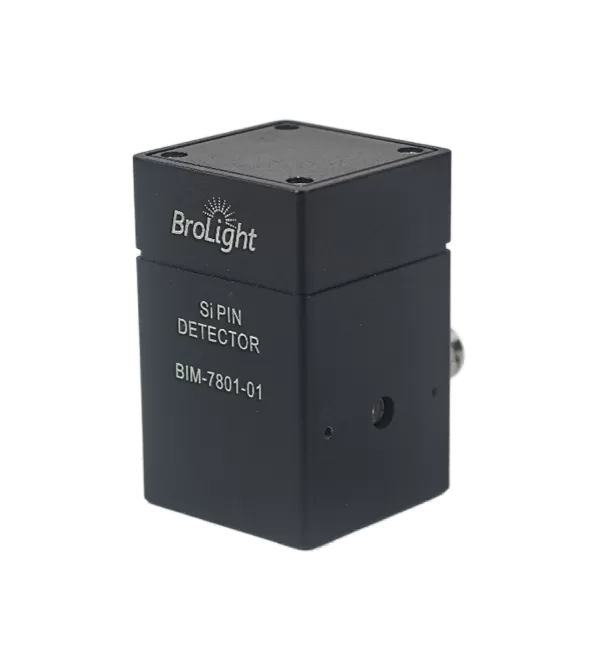
- 2GHz Bandwidth, 200ps Rise Time, Enabling Time-Frequency Domain Testing of Q-Switched and Mode-Locked Lasers
Introduction
In fields such as laser technology, nonlinear optics, and optoelectronic device characterization, engineers and researchers often face a common challenge: How to accurately measure an optical pulse lasting mere sub-nanoseconds or even hundreds of picoseconds?
Whether it's the giant pulse output of Q-switched lasers (1-100ns), the ultrashort pulse trains of mode-locked lasers (~100ps), or the high-speed signals of externally modulated continuous-wave lasers, precisely capturing the time-domain waveform of optical signals is critical for evaluating device performance and optimizing system design.
To "see" these transient optical signals, you need a pair of sufficiently "fast" eyes—a high-speed photodetector.
Brolight's BIM-780X Series High-Speed Photodetectors offer up to 2GHz bandwidth and <200ps rise time, specifically designed for measuring optical pulses from nanosecond to hundred-picosecond levels. This article will discuss key selection considerations and typical application scenarios from an application requirements perspective.
Part 1: BIM-780X Series High-Speed Photodetector Solution
1.1 Product overview
The BIM-780X Series High-Speed Photodetectors integrate high-response-speed PIN photodiodes, with Si or InGaAs material options based on the detection wavelength range. The photodiode converts optical power into current using the photovoltaic effect. When terminated with 50Ω, it can be connected to an oscilloscope to measure laser pulse width, or to a spectrum analyzer to measure laser frequency response.
Application Scenario | Typical Pulse Width | Required Detector Bandwidth |
Q-Switched Lasers | 1-100 ns | ≥10 MHz |
Mode-Locked Lasers (sub-nanosecond/hundred-picosecond) | 150-300 ps | 2GHz (meets requirements) |
Mode-Locked Lasers (picosecond) | <100 ps | ≥3.5 GHz |
This bandwidth range primarily targets the following ultrafast laser measurement and optoelectronic device characterization applications:
Key Features:
High-Speed Response: Rise/fall time <200ps, bandwidth up to 2GHz, designed for nanosecond to hundred-picosecond pulse measurement
Built-in Bias: Built-in long-life battery-powered bias supply, plug-and-play, no external power supply needed
Compact Size: 35×35×55mm dimensions, 110g weight, flexible placement in compact optical setups
Optical Input Options: Supports free-space input (-01/-02) or FC fiber connector (-01F/-02F), optional SMA905 adapter
Easy Mounting: Bottom M4/8-32 threaded holes for post mounting, convenient positioning on optical tables
1.2 About the "Acceptance Angle" Parameter
Acceptance Angle refers to the angular range over which a detector can effectively collect incident light. Differences in acceptance angle arise from variations in detector materials and chip packaging design, inherent optical characteristics of the product. When the beam is incident at an angle greater than the acceptance angle, detector responsivity decreases significantly. This parameter applies only to free-space optical input; for fiber input, the light is already constrained within the fiber and is unaffected by acceptance angle.
The acceptance angle itself does not directly affect pulse width measurement results (pulse width is determined by the detector's rise/fall time), but it does affect signal collection efficiency—when the acceptance angle is too small, more precise optical alignment is required; otherwise, the signal-to-noise ratio decreases.
1.3 Free-Space Optical Input Usage (for -01/-02 models)
When measuring laser pulses with BIM-780X detectors, three different optical input methods can be used, all subject to the acceptance angle limitations above:
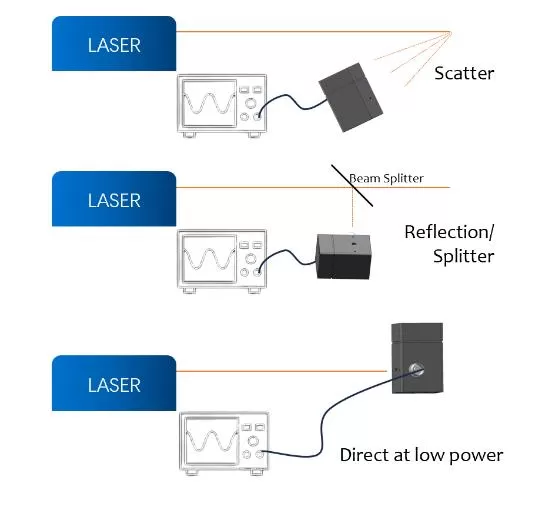
1. Scattered Light Measurement (SCATTER): Direct the laser beam away from the detector's photosensitive surface, allowing only scattered light from the measured surface to enter the detector. This method avoids saturation from direct high-power illumination, suitable for high-power pulse measurement.
2. Reflected/Split Light Measurement (REFLECTION/SPLITTER): Use part of the laser beam reflected from the measured surface to enter the detector. This prevents reflected light from returning to the laser and affecting its stability, while controlling optical energy entering the detector by adjusting the reflection angle.
3. Low-Power Direct Incidence (DIRECT AT LOW POWER): Directly aim the laser beam at the center of the detector's photosensitive surface. This method is simple and intuitive but requires strict control of optical power to avoid exceeding the saturation power (≥10mW) and damaging the detector.
Key Point: Pulse width measurement focuses on the rise/fall characteristics of the signal in the time domain—only a portion of the optical signal is needed to complete the measurement, not the full optical power. Scattered and reflected/split light measurements are typical examples of this partial-light measurement approach, while low-power direct incidence is suitable for continuous wave or low-power pulse measurements.
Fiber Input Usage (for -01F/-02F models):
Simply connect the FC connector of the fiber patch cable directly to the detector's FC input interface
No optical alignment needed, plug-and-play
Optional SMA905 adapter available for different fiber interface types
Mounting: Use the M4/8-32 threaded holes on the bottom of the detector to mount it on a post, then secure the post on an optical table or post holder, facilitating optical alignment and position adjustment.
1.4 Product Series Selection Guide
Model | Detector Material | Wavelength Range (nm) | Rise/Fall Time (ps) | Bandwidth (GHz) | Active Diameter (mm) | Acceptance Angle | Interface Type |
BIM-7801-01/01F | Si | 380-1100 | <200 | 2 | 0.1 | 45° | Free-space/FC |
BIM-7801-02/02F | Si | 380-1100 | <270 | 1.5 | 0.2 | 45° | Free-space/FC |
BIM-7803-01/01F | InGaAs | 900-1700 | <200 | 2 | 0.08 | 25° | Free-space/FC |
Brief Description:
BIM-7801 Series: Suitable for visible to near-infrared (380-1100nm) pulse measurement
BIM-7803 Series: Suitable for near-infrared and short-wave infrared (900-1700nm) pulse measurement, e.g., 1064nm, 1310nm, 1550nm
1.5 Key Specifications Details
Parameter | BIM-7801-01 | BIM-7803-01 | Description |
Rise/Fall Time | <200ps | <200ps | Can measure optical pulses ≥200ps |
Bandwidth | 2GHz | 2GHz | BW = 0.35/Tr |
Responsivity | 0.4A/W@700nm | 0.95A/W@1550nm | Affects signal-to-noise ratio |
Dark Current | 1pA | 80pA | Lower value means less noise |
Saturation Power | ≥10mW | ≥10mW | Maximum measurable optical power |
Active Diameter | 0.1mm | 0.08mm | Ensure spot is properly centered |
Acceptance Angle | 45° | 25° | Affects optical alignment requirements |
Built-in Battery | 9V | 6V | No external bias needed |
1.6 Usage Precautions
1. 50Ω Termination: Proper 50Ω termination is required to achieve correct waveform and specified bandwidth. Most oscilloscopes have a "50Ω" input impedance option in channel settings; if not available, an external 50Ω feed-through terminator must be used.
2. Avoid High-Power Direct Illumination: Although the saturation power is ≥10mW, prolonged exposure to high-power lasers should still be avoided to prevent detector damage.
3. Center the Spot on the Photosensitive Surface: With active diameters of only 0.1-0.2mm (0.08mm for BIM-7803), ensure the spot is precisely centered on the detector's active area.
4. Pay Attention to Acceptance Angle Limitations: The BIM-7803 has a 25° acceptance angle, requiring more precise optical alignment; the BIM-7801 has a 45° acceptance angle, with relatively looser alignment requirements.
5. Secure Mounting: Use the bottom M4/8-32 threaded holes to mount the detector on a post, then secure the post on the optical table to ensure stable detector positioning and easy repositioning.
Part 2: Typical Application Scenarios
2.1 Q-Switched Laser Output Monitoring – Pulse Width Measurement
Q-switched lasers produce nanosecond giant pulses (1-100ns) and are core light sources for laser marking, cutting, medical, and other applications. Accurately measuring pulse width is key to evaluating laser performance and stability.
Test Setup: BIM-780X Detector + Oscilloscope (≥500MHz bandwidth)
Measurement Parameters: Pulse width (FWHM), rise time, fall time, peak power
Selection Suggestion: 2GHz bandwidth far exceeds the nanosecond pulse measurement requirement (≥10MHz), allowing the BIM-780X to accurately reproduce pulse waveforms without broadening error.
2.2 Mode-Locked Laser Output Monitoring – Sub-Nanosecond Pulse Measurement
Mode-locked lasers produce picosecond to femtosecond ultrashort pulses and are core tools for ultrafast spectroscopy and nonlinear optics research. The BIM-780X Series can measure pulse widths ≥200ps.
Test Setup: BIM-780X Detector + High-Speed Oscilloscope (≥5GHz)
Measurement Parameters: Pulse width, repetition rate, pulse train stability
Application Boundary Note: For ultrashort pulses <200ps, the measurement results from the BIM-780X will be "broadened" by the detector's rise time and will not reflect the true pulse width. For such cases, higher bandwidth detectors (>10GHz) or autocorrelators are recommended for accurate measurement.
2.3 Optoelectronic Device Time-Domain and Frequency-Domain Response Measurement
In the R&D and production of optoelectronic devices such as photodetectors and modulators, frequency response and pulse response are core performance indicators. The BIM-780X can serve as a reference standard for evaluating device performance with bandwidth ≤2GHz.
Test Setup:
Measurement Parameters: Device rise time, bandwidth, gain flatness
Knowledge Supplement: Difference Between Spectrum Analyzer and Oscilloscope
Oscilloscope: Observes signal variation over time (time domain), used for measuring pulse width, rise time, etc.
Spectrum Analyzer: Analyzes the frequency components of a signal (frequency domain), used for measuring frequency response, harmonic distortion, modulation characteristics, etc.
Both are complementary in optoelectronic measurement, and the BIM-780X Series can meet both testing needs simultaneously.
2.4 Product Applicability Summary
Application Scenario | Typical Pulse Width | BIM-780X Recommended | Description |
Q-Switched Lasers | 1-100ns | ✅ Strongly Recommended | 2GHz bandwidth is more than sufficient, accurate waveform reproduction |
Mode-Locked Lasers (sub-nanosecond) | 150-300ps | ✅ Recommended | Can measure pulses ≥200ps |
Mode-Locked Lasers (picosecond) | <100ps | ❌ Not Recommended | Requires >10GHz detector or autocorrelator |
Gain-Switched Lasers | 20-100ps | ❌ Not Recommended | Exceeds accurate measurement range |
Optical Communication Signals (2.5Gbps and below) | >200ps | ✅ Recommended | 2GHz bandwidth can cover 2.5Gbps NRZ signals |
Optical Communication Signals (10Gbps and above) | <100ps | ❌ Not Recommended | Requires >10GHz detector |
Part 3: Summary
Brolight's BIM-780X Series High-Speed Photodetectors combine 2GHz bandwidth, <200ps rise time, built-in bias, compact portability, and rich interface options—an ideal choice for Q-switched lasers, mode-locked lasers (sub-nanosecond), and 2.5Gbps and below optical communication signals.
About Brolight
Brolight, an independent brand under A&P Instrument, focuses on the R&D, manufacturing, and integrated solutions of photonics testing equipment and lab instruments. Leveraging A&P Instrument's over 40 years of technological heritage and market expertise in the photonics industry, Brolight precisely addresses the diverse needs of scientific research, industrial inspection, and experimental teaching. With exceptional photonics products and lab instruments, we build a reliable and efficient application foundation for research institutions, industrial enterprises, and educators worldwide.
 EN
EN
 jp
jp  ko
ko  fr
fr  de
de  es
es  tr
tr  ru
ru  pt
pt  ar
ar  vi
vi