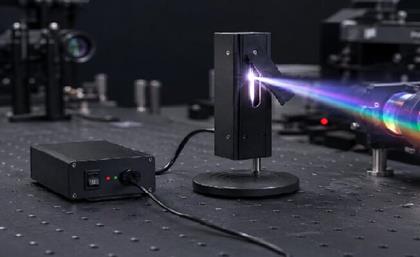
Product Essence: Precision Current Source with PID Feedback
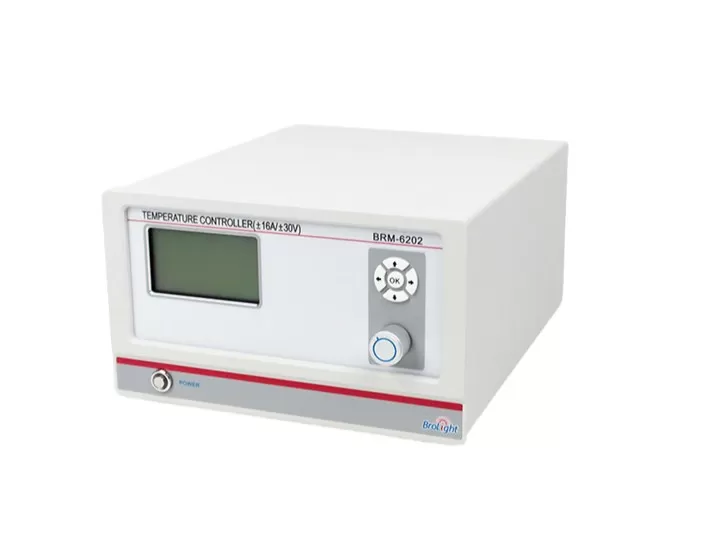
The BRM-620X series temperature controller is essentially a precision current source with PID feedback control, designed specifically to drive TECs (Thermoelectric Coolers) or resistive heaters. Its core operating mechanism has two modes:
Closed-Loop Control Mode (PID Feedback): The controller receives a feedback signal from a temperature sensor, compares the current temperature with the setpoint, calculates the required drive current using a PID algorithm, and outputs it to the TEC or heater. This accurately stabilizes the object at the target temperature. This is the standard operating mode for precision temperature control.
Open-Loop Output Mode (Manual Control): The controller does not rely on temperature sensor feedback and directly outputs based on a user-set voltage or current. In this mode, the controller acts as a programmable DC current source, suitable for heating devices without integrated temperature sensors or for test scenarios requiring manual output power control.
Easy Understanding: Closed-loop mode is like a “constant temperature air conditioner” – a thermometer measures temperature, and the AC adjusts cooling/heating power based on the difference. Open-loop mode is like an “adjustable electric stove” – you set the power, and it outputs that power, regardless of the actual temperature.
Key Understanding: The BRM-620X requires compatible TEC devices and temperature sensors to form a complete closed-loop temperature control system. The TEC acts as the actuator (cooling/heating), the temperature sensor provides feedback, and the BRM-620X dynamically calculates the necessary drive current based on the deviation.
Supporting Hardware: BRM-67xx Laser Diode Temperature Control Mount
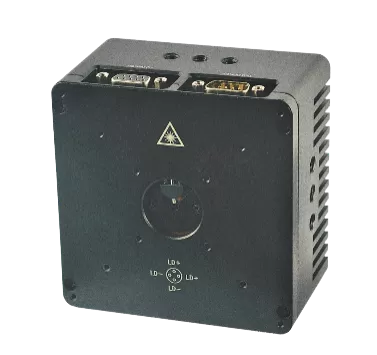
For the key application of laser diode temperature control, Brolight offers the BRM-67xx series Laser Diode Temperature Control Mount, which integrates a TEC device and a temperature sensor. Used together with the BRM-620X temperature controller, it enables rapid setup of a complete laser temperature control system.
Model | Package Type | Supported Package Types | Interface | Built-in Components | Dimensions (mm) |
BRM-6701 | TO-Can | TO-38 / 46 / 56 / 90 | 2 D-Sub ports | TEC + Temperature Sensor | 102×102×53 |
BRM-6711 | Butterfly | 14 Pin | 2 D-Sub ports | TEC + Temperature Sensor | 89×89×26 |
Key Features:
Quick Mounting: Simply insert the laser diode into the corresponding socket for device fixation and electrical connection.
Integrated Temperature Control Components: Built-in TEC and temperature sensor – no additional configuration needed.
Supports High-Current Devices: Suitable for temperature control of higher-power lasers.
Applications: Mounting and temperature-controlled testing of TO-Can packaged LD/LED and butterfly-packaged LDs. and other package type are available upon request.
System Configuration Recommendation: BRM-620X Temperature Controller + BRM-67xx Temperature Control Mount + Laser Diode = Complete laser temperature control test solution. The mount has a built-in TEC and sensor – insert the laser and start precise temperature control experiments.
Temperature Control Requirements in Photonics Experiments
The performance of photonic devices is highly dependent on temperature:
Laser diode wavelength drift coefficient: 0.03-0.1 nm/°C
Detector dark current has an exponential relationship with temperature (doubles every 7-10°C increase)
Phase-matching conditions for nonlinear crystals are extremely sensitive to temperature (typically requiring ±0.1°C)
The BRM-620X series temperature controller uses a PID control algorithm, working with a TEC (Thermoelectric Cooler) or resistive heater, to precisely control the device to your set target temperature, achieving a temperature control accuracy of ±0.1°C with stable maintenance.
Two Core Objectives: Stabilize vs. Scan
Users typically employ temperature controllers for two distinct purposes:
Objective Type | Core Requirement | Typical Scenario | Control Requirement |
Stabilize at Optimum Temperature | Find the “best temperature point” and keep the device there | Laser frequency stabilization, detector cooling for noise reduction | High stability (minimal drift) |
Set Arbitrary Temperature on Demand | Make the device work at “my desired temperature,” possibly multiple different temperatures | Variable-temperature spectroscopy, device temperature characteristic testing | High precision + wide range |
Easy Understanding: The first is like “letting the device live in the best room and never move”; the second is like “asking the device to live at 25°C today, 50°C tomorrow, -10°C the day after, and be accurate every time.”
The BRM-620X can do both: It offers long-term stability (temperature control accuracy ±0.1°C) and wide-range precise setting capability (supporting settings from below room temperature to over 100°C).
How to Select: Five Core Decisions
Decision 1: Do you want to “stabilize” or “scan”?
Your Core Need | Focus | Key Selection Parameters |
Long-term stabilization at a set temperature (e.g., laser frequency stabilization) | Stability | Temperature stability (°C), long-term drift |
Switching or scanning between multiple temperature points (e.g., variable-temperature experiments) | Setting capability | Temperature range, heating/cooling rate, setting accuracy |
Decision 2: How high a temperature control accuracy do you need?
Different applications have vastly different requirements for temperature stability:
Application Scenario | Required Accuracy | Note |
Routine lab environment, non-wavelength-sensitive applications | ±0.1°C | BRM-620X can meet this. |
Routine laser diode frequency stabilization, 25GHz channel spacing DWDM systems | ±0.1°C | Literature indicates ±0.1°C meets 25GHz spacing requirements. |
Narrow-channel DWDM (12.5GHz and below), precision tunable laser frequency stabilization, precision spectroscopy | ±0.01°C or higher | Requires higher-spec controller; BRM-620X accuracy is ±0.1°C – evaluate if it meets your needs. |
Note: The BRM-620X has a temperature control accuracy of ±0.1°C, suitable for routine lab temperature control and 25GHz channel spacing DWDM systems. If your application requires ±0.01°C-level accuracy, please consult us about higher-spec products.
Decision 3: How much drive power do you need for your TEC/heater?
Choose a controller with sufficient drive capability based on the power consumption of your device and the required temperature range:
Insufficient drive capability → Inability to reach the target temperature or slow temperature control response.
Excessive drive capability → Potential temperature overshoot, affecting stability.
Selection Suggestion: Choose a model with drive capability slightly higher (20-30% margin) than your actual needs for optimal control response.
Decision 4: What supporting hardware do you need?
A temperature control system requires TEC devices and temperature sensors to function. For laser diode temperature control, Brolight offers the BRM-67xx series Temperature Control Mount with built-in TEC and sensor, ready to use:
Decision 5: Is PID auto-tuning needed?
PID parameters determine the control response speed, stability, and disturbance rejection.
Fixed load, long-term operation → Manually tune PID once, use long-term.
Multiple loads switching, exploratory research experiments → Auto-tuning saves significant time.
Typical Application Scenarios
Scenario 1: Laser Diode Temperature Stabilization (Stabilize at Optimum Temperature)
Laser wavelength drifts with temperature. In applications requiring precise wavelength control (e.g., tunable lasers), a TEC is used to stabilize the laser diode chip at an optimal operating temperature. The ±0.1°C control accuracy meets routine frequency stabilization needs.
System Solution: BRM-620X Temperature Controller + BRM-67xx Temperature Control Mount (with built-in TEC and sensor) + Laser Diode
*BRM-620X’s role: Closed-loop PID control, dynamically adjusting TEC drive current based on temperature sensor feedback – letting the laser “live in the best room,” controlling wavelength drift to approximately 0.003-0.01nm.*
Scenario 2: Photodetector Cooling (Stabilize at Optimum Temperature)
In low-light detection, dark current is a major noise source. Dark current has an exponential relationship with temperature – lowering temperature exponentially suppresses dark current. The temperature controller, working with a TEC, can cool the detector to -20°C or even lower and maintain it stably (accuracy ±0.1°C).
*BRM-620X’s role: Closed-loop PID control – letting the detector “calm down,” minimizing dark current.*
Scenario 3: Nonlinear Crystal Temperature Control (Stabilize at Optimum Temperature)
In nonlinear optical processes like second-harmonic generation and sum-frequency generation, phase-matching conditions are extremely temperature-sensitive. Each crystal and operating wavelength has its optimum phase-matching temperature. The temperature controller must stabilize the crystal at that temperature (accuracy ±0.1°C is a common requirement) to maintain optimal conversion efficiency.
*BRM-620X’s role: Closed-loop PID control – letting the crystal “align the phase,” maximizing efficiency.*
Scenario 4: Device Temperature Characteristic Testing (Set Arbitrary Temperature on Demand)
Studying the performance of photodetectors, LEDs, lasers at different temperatures (e.g., output power vs. temperature, peak wavelength vs. temperature, dark current vs. temperature). This requires the temperature controller to sequentially control the device to a set temperature sequence (e.g., 0°C → 10°C → 20°C → 30°C → 40°C), stabilizing at each point for measurement.
*BRM-620X’s role: Closed-loop PID control – letting the device “experience different temperatures as you command.”*
Scenario 5: Variable-Temperature Spectroscopy / Variable-Temperature Fluorescence (Set Arbitrary Temperature on Demand)
In materials science, measuring a sample’s absorption, fluorescence, or Raman spectra at different temperatures is common. The temperature controller must precisely set and maintain the temperature at each measurement point.
*BRM-620X’s role: Closed-loop PID control – letting the sample “heat up/cool down as required,” working with a spectrometer to complete scans.*
Scenario 6: Open-Loop Heating without Feedback (Open-Loop Output Mode)
For heating devices without integrated temperature sensors (e.g., some resistive heating pads, temperature-controlled ovens), or for test scenarios requiring manual output power control, directly set the output voltage or current. In this mode, it acts as a programmable DC current source.
*BRM-620X’s role: Open-loop output mode – independent of temperature sensors, outputs current according to user-set values.*
Summary
The BRM-620X’s core capability is “keeping your photonic device at your desired temperature point” – in closed-loop mode, it dynamically adjusts TEC drive current based on temperature sensor feedback, achieving ±0.1°C temperature control accuracy; in open-loop mode, it can be used as a programmable DC current source.
System Setup Reminder: The BRM-620X requires compatible TEC devices and temperature sensors to be used. For laser diode temperature control, Brolight offers the BRM-67xx series Temperature Control Mount (with built-in TEC and sensor), enabling rapid setup of a complete laser temperature control test solution.
 EN
EN
 jp
jp  ko
ko  fr
fr  de
de  es
es  tr
tr  ru
ru  pt
pt  ar
ar  vi
vi