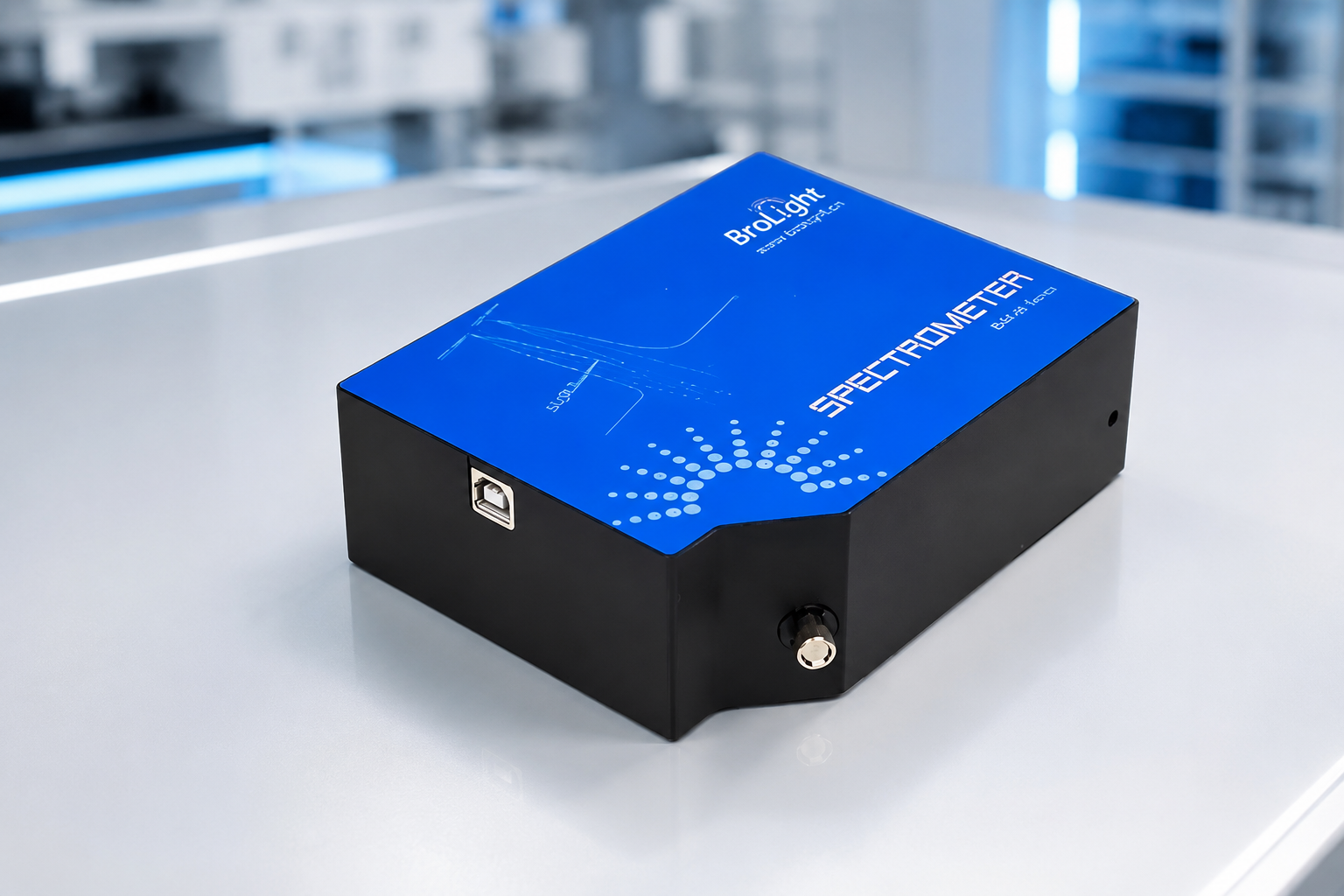
A CCD spectrometer is an optical instrument that separates incoming light into different wavelengths and uses a CCD detector to measure light intensity across the spectrum. It is widely used in chemical analysis, light source testing, fluorescence measurement, material inspection, color analysis, education, OEM instruments and industrial monitoring.
For buyers, a CCD spectrometer should not be selected only by wavelength range. Resolution, sensitivity, signal-to-noise ratio, slit width, grating design, detector performance, software, calibration and integration method all affect real measurement quality. Brolight provides CCD Spectrometer, Miniature Spectrometer and high-resolution spectroscopy solutions for research, teaching and industrial applications.
What Is a CCD Spectrometer?
A CCD spectrometer is a spectrometer that uses a charge-coupled device detector to convert dispersed light into measurable electrical signals. In simple terms, the optical system spreads light by wavelength, and the CCD array records the intensity of each wavelength channel.
A typical CCD spectrometer includes an entrance slit, collimating mirror, diffraction grating, focusing mirror, CCD detector and software. Light enters the slit, is collimated into a beam, dispersed by the grating, focused onto the CCD array and converted into digital spectral data. NIST describes spectrophotometric techniques as methods used to measure reflectance, transmittance, absorbance, emittance and fluorescence, which explains why CCD spectrometers can be used across many optical testing tasks.
Brolight CCD-based spectrometers provide high-precision light analysis by measuring intensity across wavelengths. They are suitable for applications where users need compact structure, fast data acquisition and reliable spectral output.
How Does a CCD Spectrometer Work?
A CCD spectrometer works by collecting light, dispersing it into wavelengths, detecting the separated light on a CCD array and converting detector response into a spectrum. Each CCD pixel corresponds to a small wavelength interval after calibration.
The working process starts when light from a sample, lamp, laser, LED or optical fiber enters the spectrometer. The slit controls how much light enters and helps define optical resolution. The grating then separates light into different wavelengths. The CCD detector collects the dispersed spectrum at the same time, allowing rapid multi-wavelength measurement.
Wavelength calibration is critical because the spectrometer must correctly map CCD pixels to wavelength values. NIST’s guide on wavelength calibration and spectral response correction for CCD array spectrometers explains that calibration checks the grating angular position and the assignment of wavelengths to individual CCD pixels. This is why a good CCD spectrometer requires both optical hardware quality and reliable calibration.
Key Components and Performance Factors
CCD spectrometer performance is determined by how well the optical system, detector and software work together. A high-quality detector alone cannot compensate for poor optics, unstable calibration or the wrong slit/grating configuration.
| Component / Factor | Main Function | Buyer Consideration |
|---|
| Entrance Slit | Controls input light width | Narrow slit improves resolution but reduces signal |
| Diffraction Grating | Separates light by wavelength | Affects wavelength range and optical resolution |
| CCD Detector | Converts photons into electrical signals | Impacts sensitivity, noise and dynamic range |
| Optical Resolution | Separates close spectral peaks | Brolight high-resolution models can reach 0.08nm |
| Wavelength Range | Defines measurable spectrum region | Match UV, VIS, NIR or full-range application needs |
| Signal-to-Noise Ratio | Shows usable signal quality | Important for weak light and fluorescence testing |
| Software | Displays, saves and analyzes spectra | Check calibration, export, SDK and integration support |
The diffraction grating is especially important. A technical guide on spectrometer diffraction gratings explains that the grating helps determine both optical resolution and wavelength range. For users, this means a spectrometer optimized for wide spectral coverage may not deliver the same fine resolution as a narrower-range system.
Brolight’s High Resolution Spectrometer achieves up to 0.08nm optical resolution across UV-VIS-NIR ranges, making it suitable for laser analysis, emission spectra, absorption measurement and applications that require fine spectral detail.
CCD Spectrometer vs Other Spectrometer Types
CCD spectrometers should be compared with CMOS, photodiode-array and scanning spectrometers according to speed, sensitivity, cost, resolution and integration requirements. The best detector type depends on the measurement task, not only on one specification.
| Spectrometer Type | Main Advantage | Typical Use | Limitation |
|---|
| CCD Spectrometer | High sensitivity and fast full-spectrum capture | Fluorescence, emission, absorbance, teaching, research | May need cooling for very weak signals |
| CMOS Spectrometer | Compact, fast and cost-effective | Portable devices, OEM modules, field testing | Performance varies by sensor design |
| Photodiode Array Spectrometer | Simultaneous multi-wavelength detection | Process monitoring, UV-Vis instruments | Lower pixel density than some CCD systems |
| Scanning Monochromator | High wavelength selectivity | Precise lab measurement | Slower because it scans wavelengths sequentially |
| NIR Spectrometer | Measures near-infrared absorption | Food, polymer, agriculture, material testing | Not suitable for UV-visible-only applications |
For compact product development, Brolight’s miniature spectrometers are useful because they use a compact optical-mechanical platform and can support portable analysis, OEM integration and industrial monitoring. For low-light applications, CCD-based systems are often preferred because sensitivity and simultaneous full-spectrum acquisition are important.
How to Choose the Right CCD Spectrometer
Choosing the right CCD spectrometer means matching wavelength range, optical resolution, sensitivity, slit width, grating, detector type, software interface and light source to the final application. A spectrometer used for LED color testing will not need the same configuration as one used for Raman, fluorescence or UV absorbance.
For light source and LED testing, focus on wavelength range, integration time, intensity calibration and repeatability. For fluorescence or weak emission, sensitivity and signal-to-noise ratio are more important. For laser analysis, optical resolution and wavelength accuracy are critical. For OEM instruments, size, communication protocol, software development support and long-term supply stability should be checked early.
Before requesting a quotation, buyers should prepare the sample type, wavelength range, expected signal level, required resolution, measurement speed, optical input method, software requirements and installation environment. Brolight can help users select CCD spectrometers, miniature spectrometers, high-resolution spectrometers, light sources, optical fibers and accessories according to research, industrial or OEM project needs.
Conclusion
A CCD spectrometer works by separating light into wavelengths and using a CCD detector array to record the intensity distribution as a spectrum. Its main advantages are fast full-spectrum acquisition, good sensitivity and flexible use in optical testing, chemistry, materials, education and OEM instruments.
For buyers, the right CCD spectrometer should be selected according to application needs rather than only price or wavelength range. Slit, grating, detector, resolution, sensitivity, calibration and software all determine final measurement quality. Brolight provides CCD spectrometers, miniature spectrometers, high-resolution spectrometers and optical measurement solutions for users who need reliable spectral analysis.
FAQ
1. What is a CCD spectrometer?
A CCD spectrometer is an optical instrument that disperses light into wavelengths and uses a CCD detector array to measure spectral intensity.
2. How does a CCD spectrometer work?
It collects light through a slit, disperses it with a grating, focuses the separated wavelengths onto a CCD detector and converts the detector response into a spectrum.
3. What is the role of the diffraction grating?
The diffraction grating separates incoming light into different wavelengths and strongly affects the wavelength range and optical resolution of the spectrometer.
4. Why is wavelength calibration important?
Wavelength calibration ensures that each CCD pixel is correctly assigned to a wavelength, which is essential for accurate spectral peak identification and measurement.
5. What applications use CCD spectrometers?
CCD spectrometers are used for UV-Vis analysis, fluorescence, emission spectra, LED testing, laser analysis, material inspection, color measurement, education and OEM instruments.
6. Why choose Brolight CCD spectrometers?
Brolight offers CCD spectrometers, miniature spectrometers and high-resolution spectrometers for research, teaching, industrial monitoring and OEM optical systems, with options for different wavelength ranges and resolution needs.
 EN
EN
 jp
jp  ko
ko  fr
fr  de
de  es
es  tr
tr  ru
ru  pt
pt  ar
ar  vi
vi