A UV spectrometer works by sending ultraviolet light through or onto a sample, separating the light by wavelength, and measuring how much light is absorbed, transmitted or reflected. The result is a spectrum that helps users identify materials, quantify concentration, monitor reactions and evaluate optical properties.
In laboratory and industrial applications, UV spectrometers are widely used in chemistry, biochemistry, water analysis, coating inspection, material testing and optical instrument development. Brolight provides UV-Vis Spectrometer solutions for ultraviolet and visible absorption measurement, helping users identify and quantify compounds in research and applied testing.
What Is a UV Spectrometer?
A UV spectrometer is an optical instrument that measures how a sample interacts with ultraviolet light across selected wavelengths. In practical UV-Vis systems, the measurement often extends from the ultraviolet region into visible light, allowing users to analyze absorption peaks and spectral patterns.
Ultraviolet light is commonly discussed in the 100–400nm region, while visible light is roughly 400–700nm. Many UV-Vis instruments are configured around practical measurement ranges such as 190–1100nm, depending on the light source, grating, detector and optical path. NIST explains that spectrophotometric techniques are used to measure reflectance, transmittance, absorbance, emittance and fluorescence.
For buyers, this means a UV spectrometer is not only a “light detector.” It is a complete optical measurement system that turns light-sample interaction into useful spectral data.
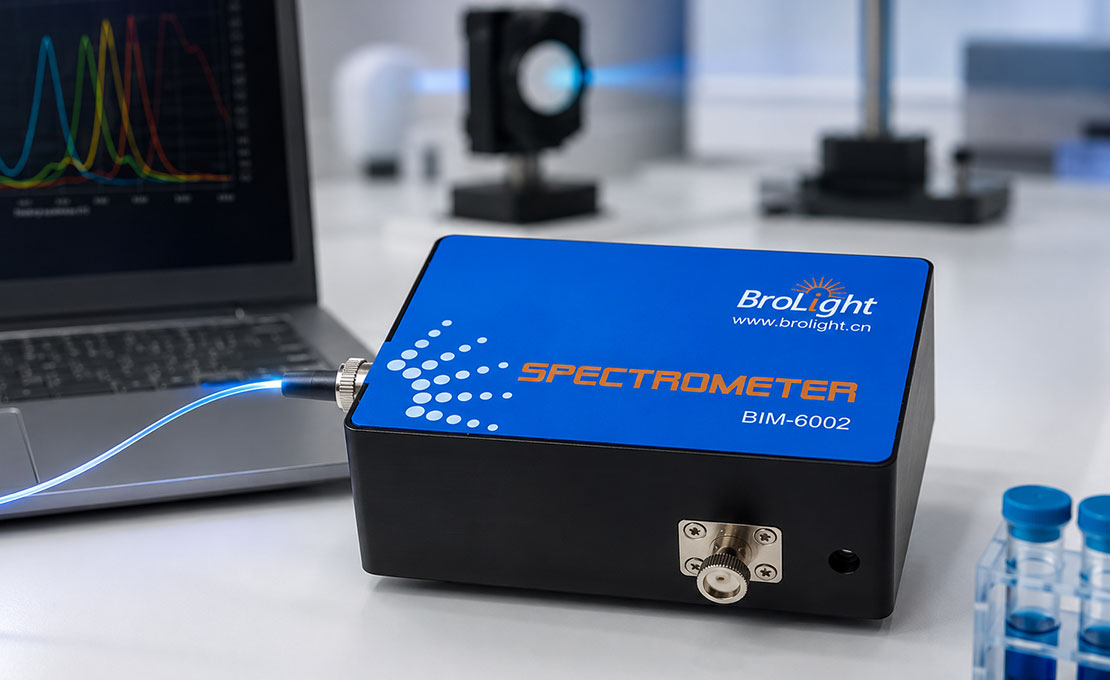
How Does a UV Spectrometer Work Step by Step?
A UV spectrometer works by generating UV light, guiding it through the sample, separating wavelengths, detecting light intensity and converting the signal into a spectrum. The instrument compares incident light and transmitted or reflected light to calculate optical information.
The process usually starts with a UV light source. A deuterium lamp is commonly used for ultraviolet measurement because it can provide continuous UV output. Brolight’s Deuterium Light Source supports UV applications and features dual-channel independent control for deuterium and tungsten lamps, allowing users to cover UV and visible measurement needs.
Next, light is guided through optical fibers, lenses or a cuvette holder. When the beam passes through the sample, certain wavelengths are absorbed by molecules or materials. The remaining light enters the spectrometer, where a diffraction grating separates it into individual wavelengths. A detector then records the intensity at each wavelength and software displays the spectrum.
For concentration measurement, UV spectroscopy often follows the Beer-Lambert relationship. A peer-reviewed article on the Bouguer-Beer-Lambert Law explains how absorbance is related to light transmission through a material. In simple analytical use, higher concentration usually creates higher absorbance at the target wavelength when the method is properly calibrated.
Key Components of a UV Spectrometer
The key components of a UV spectrometer include the light source, sample holder, entrance slit, collimating optics, diffraction grating, detector and software. Each component affects wavelength range, resolution, sensitivity, repeatability and measurement accuracy.
| Component | Main Function | Buyer Consideration |
|---|
| UV Light Source | Provides ultraviolet radiation | Deuterium lamp stability, UV intensity, lifetime |
| Sample Holder | Positions cuvette, fiber probe or optical sample | Path length, material compatibility, repeatability |
| Entrance Slit | Controls incoming light width | Affects resolution and signal intensity |
| Diffraction Grating | Separates light by wavelength | Determines spectral range and dispersion |
| Detector | Converts light into electrical signal | Sensitivity, noise level, response range |
| Software | Displays and analyzes spectra | Calibration, export, integration and automation |
| Optical Fiber | Transfers light between modules | UV transmission, connector type and flexibility |
Resolution is a key specification. Brolight’s Miniature Spectrometer adopts a compact optical-mechanical platform for portable analysis, OEM integration and industrial monitoring. The BIM-6001A Series Miniature Spectrometer offers up to 0.35nm optical resolution in a compact platform, which is useful when users need to distinguish closely spaced spectral features.
Accuracy also depends on calibration and traceability. NIST notes that UV/visible/NIR spectrophotometry traceability relies on reference materials that support accurate transmittance or absorbance measurements at specified wavelengths.
How to Choose a UV Spectrometer for Your Application
Choosing a UV spectrometer means matching wavelength range, optical resolution, sensitivity, light source, sample type and software interface to the measurement task. A system for routine absorbance testing may need different specifications from an OEM process-monitoring instrument.
For liquid concentration analysis, focus on wavelength accuracy, photometric repeatability, cuvette path length and stable UV output. For water quality monitoring, check whether the system supports UV254, nitrate or multi-parameter spectral calibration. For optical materials, coatings and filters, transmittance and reflectance accessories may be required. For OEM applications, compact size, USB communication, SDK support and long-term component availability become important.
Brolight’s High Resolution Spectrometer is suitable for applications requiring fine spectral detail, while Brolight miniature and UV-Vis spectrometers support portable, laboratory and integrated optical measurement tasks. Before requesting a quotation, buyers should prepare wavelength range, sample type, expected absorbance level, resolution requirement, test speed, optical interface and software integration needs.
Conclusion
A UV spectrometer works by using ultraviolet light to measure how a sample absorbs, transmits or reflects different wavelengths. The core workflow is light generation, sample interaction, wavelength separation, detection and software analysis. Because many substances show characteristic UV absorption behavior, UV spectroscopy is useful for identification, concentration measurement, quality control and material evaluation.
For buyers, the best UV spectrometer is not simply the most expensive model. It is the system that fits the wavelength range, resolution, light source stability, sample format and application workflow. Brolight provides UV-Vis spectrometers, miniature spectrometers, high-resolution spectrometers and deuterium light sources to support laboratory analysis, OEM instruments and industrial optical testing.
FAQ
1. What does a UV spectrometer measure?
A UV spectrometer measures how much ultraviolet light is absorbed, transmitted or reflected by a sample across selected wavelengths.
2. What is the working principle of a UV spectrometer?
The working principle is to pass UV light through or onto a sample, separate the light by wavelength and detect intensity changes to generate a spectrum.
3. Why is a deuterium lamp used in UV spectroscopy?
A deuterium lamp is used because it provides continuous and stable ultraviolet light, commonly covering the UV region needed for absorbance measurement.
4. What is absorbance in UV spectroscopy?
Absorbance describes how much light a sample absorbs at a given wavelength. It is often used to estimate concentration when the method follows Beer-Lambert behavior.
5. What affects UV spectrometer accuracy?
Accuracy is affected by wavelength calibration, light source stability, detector noise, stray light, sample path length, cuvette quality and reference measurement.
6. Why choose Brolight UV spectrometer solutions?
Brolight offers UV-Vis spectrometers, miniature spectrometers, high-resolution spectrometers and deuterium light sources for chemical analysis, water testing, material measurement, OEM integration and research applications.
 EN
EN
 jp
jp  ko
ko  fr
fr  de
de  es
es  tr
tr  ru
ru  pt
pt  ar
ar  vi
vi