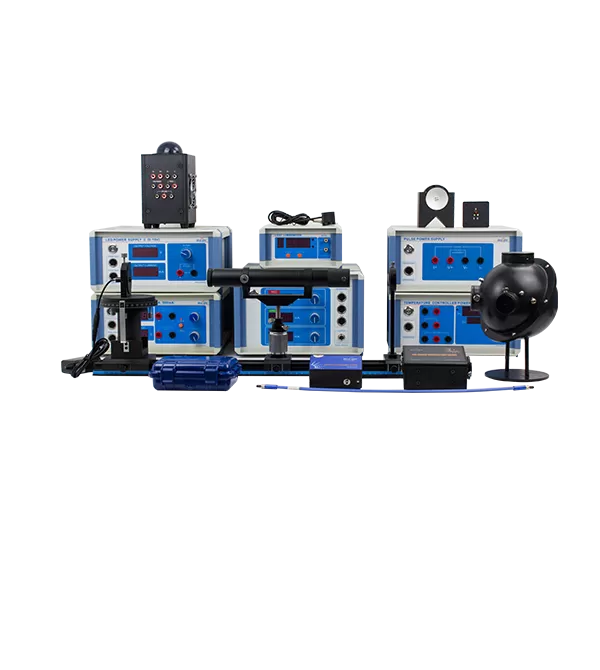
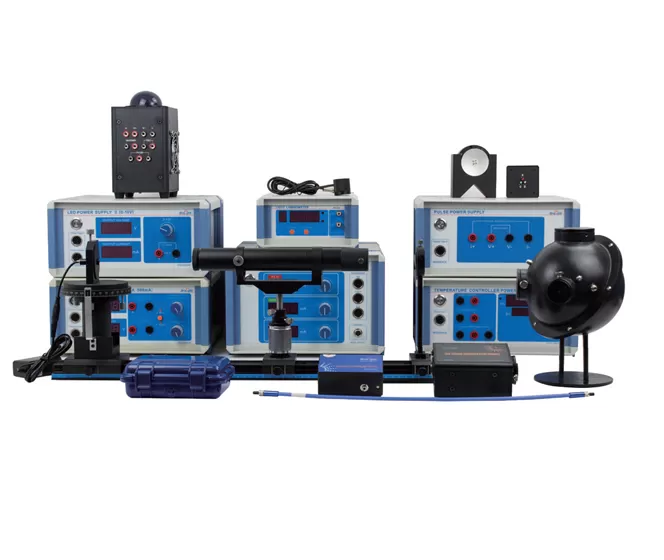
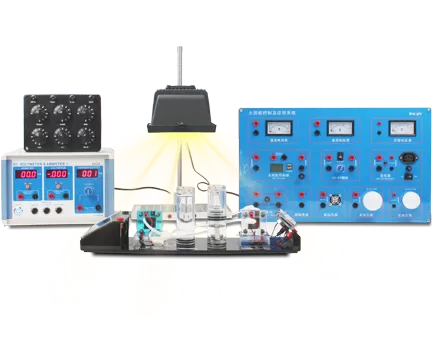
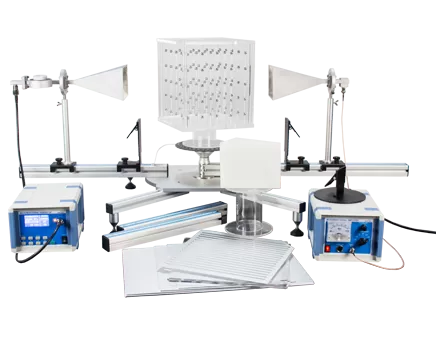
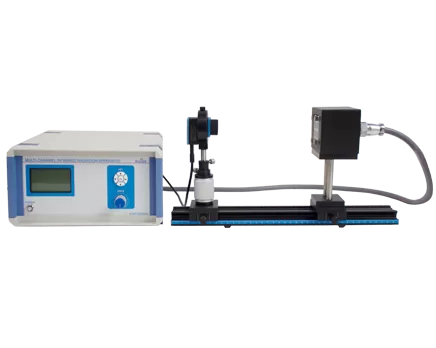
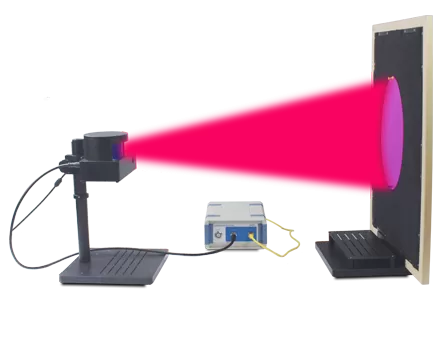
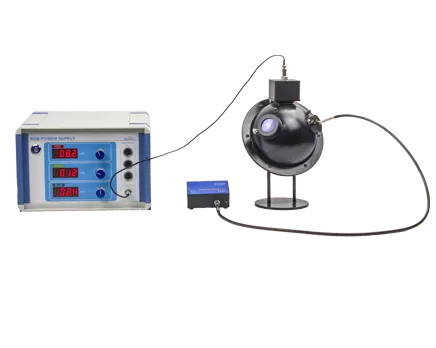
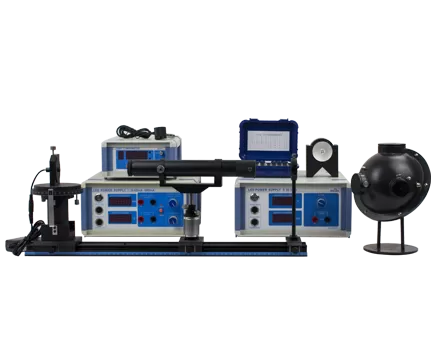
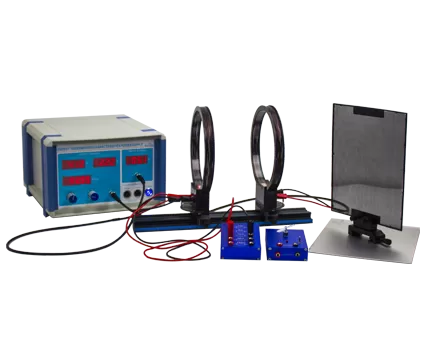
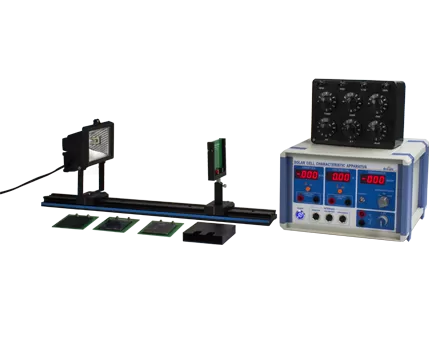
The experiment is rich in content and comprehensively covers the four most important characteristics of LED - light, electricity, color and heat. It is the most basic theoretical knowledge required for the compulsory courses of optoelectronics majors in universities.
Several experiment modules are independent of each other but also mutually supportive. The function divisions of the components are clearly defined, making it easy for students to understand.
The components of the experimental device and the software design are all designed according to the standards of teaching products. The operation settings comply with teaching requirements, and the software functions are complete, including knowledge navigation, independent test modules, which enable students to have a clear logical thinking and easy understanding when using it, achieving the effect of deepening theoretical learning.
The principle of parameter testing strictly follows the current authoritative testing standards in China and abroad. For example: the average light intensity test adopts the CIE average light intensity test standard conditions; the luminous flux test adopts the integrating sphere method; the junction temperature measurement adopts the pulse current method. This method has the advantages of simplicity, non-destructiveness, accuracy and good transient response.
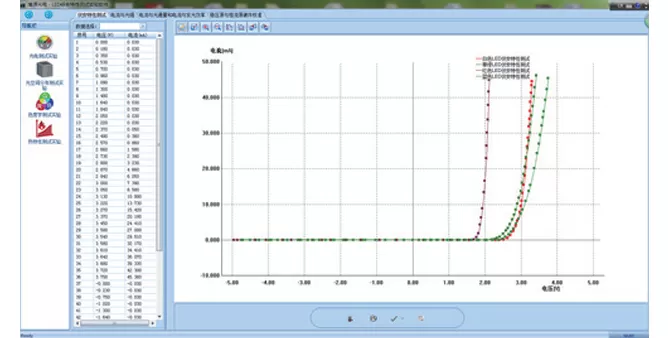
Volt-ampere characteristic test experiment.
Relationship experiment between light intensity and current.
Relationship experiment between luminous flux and current.
Measurement experiment of spatial distribution characteristics of LED output light.
Measurement experiment of chromaticity parameters of different LEDs.
RGB color matching experiment.
Measurement experiment of VT coefficient (ripple) of pulse power supply.
Measurement experiment of K coefficient.
Measurement experiment of junction temperature and thermal resistance.
NO. | Part Name | Main Parameter |
1 | LED Power Supply I (constant current source) | 110V/220V input, 0~50/500mA output, voltage range 0-10V |
2 | LED Power Supply II (constant voltage source) | 110V/220V input, 0~10V output; current range 0 - 0.1A |
3 | (Programmable) Pulse Power Supply | Output small current ranging from 0 to 50 mA; output large current ranging from 50 to 500 mA. |
4 | Temperature Control Power Supply | Heating range: 0 - 100℃ |
5 | Illuminometer with Detector | Measurable illuminance and luminous flux values, illuminance range: 0.001 LX to 2000 LX; Luminous flux range: 0.001 LM to 999 LM; |
6 | RGB Power Supply (constant current source) | Three-phase current output |
7 | Fiber Spectrometer | Wavelength range: 350-1050nm, resolution 2nm |
8 | Fan Cooling Tungsten Light Source | Wavelength range: 400 nm-2000 nm Cooling method: Fan |
9 | Temperature Controller System | Heating range 0~100℃ |
10 | Integrating Sphere | Radiation integrating sphere |
11 | LED Fixture and Holder | Dia 50mm |
NO. | Part Name | Model | Qty. |
1 | LED Power Supply I (constant current source) | BEM-5036 | 1 |
2 | LED Power Supply I (constant voltage source) | BEM-5035 | 1 |
3 | (Programmable) Pulse Power Supply | BEM-5037 | 1 |
4 | Temperature Control Power Supply | BEM-5038 | 1 |
5 | Illuminometer with Detector | BEM-5409 | 1 |
6 | RGB Power Supply (constant current source) | BEM-5711 | 1 |
7 | Fiber Spectrometer | BIM-6001-06 | 1 |
8 | Fan Cooling Tungsten Light Source | BIM-6210 | 1 |
9 | Temperature Controller System | BEM-5040A | 1 |
10 | Integrating Sphere | BEM-5216-15004 | 1 |
11 | LED Fixture and Holder | BEM-5217 | 1 |
12 | RGB Light Source Fixture | BEM-5224 | 1 |
13 | Adjustment Platform for Light Source | BEM-5214 | 1 |
14 | Aperture tube with Holder | BEM-5215 | 1 |
15 | Aperture | BEM-5221-03 | 1 |
16 | View Screen | BEM-5410 | 1 |
17 | Track | BEM-5201-06 | 1 |
18 | Carrier | BEM-5204-50 | 1 |
19 | Adjustable Post Holder | BEM-5205-25 | 1 |
20 | Poster | BEM-5209-09 | 1 |
21 | Quartz Fiber | SIM-6102-0605-S/S-P | 1 |
22 | Laser Module with Fixture | BEM-5047 | 1 |
23 | LED Test Samples with Storage Case | BEM-5048 | 1 |
24 | Power Cable | BC-105075 | 5 |
25 | USB Data Cable | BC-105080 | 2 |
26 | 4mm Banana Plug Connector Cable, Red | BC-105084 | 6 |
27 | 4mm Banana Plug Connector Cable, Black | BC-105083 | 6 |
28 | 6-Pin Aviation Connector Cable | BC-104103 | 1 |
1. Electrical & electro-optical conversion experiment
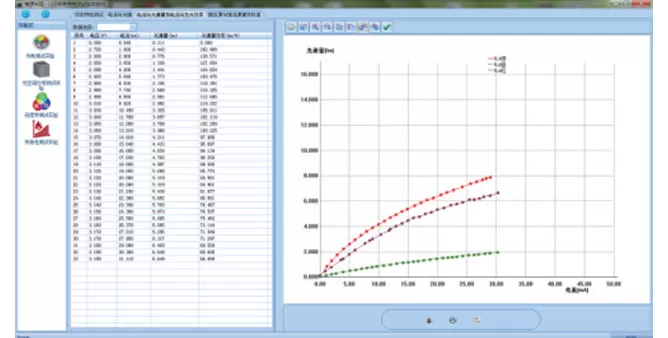
2. Investigate the relationship between current, luminous flux and luminous efficiency
3. Light spatial distribution (light distribution curve) experiment
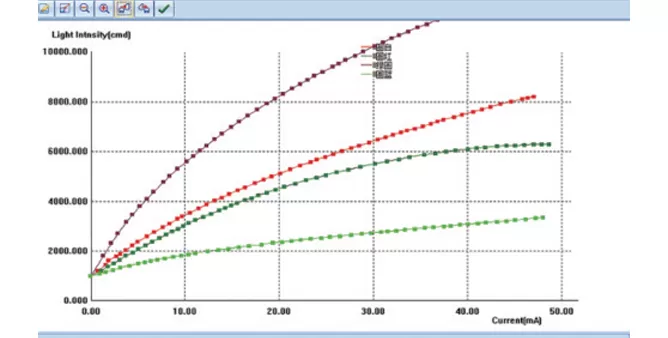
The curve showing the variation of the average
light intensity in one-dimensional space with the current
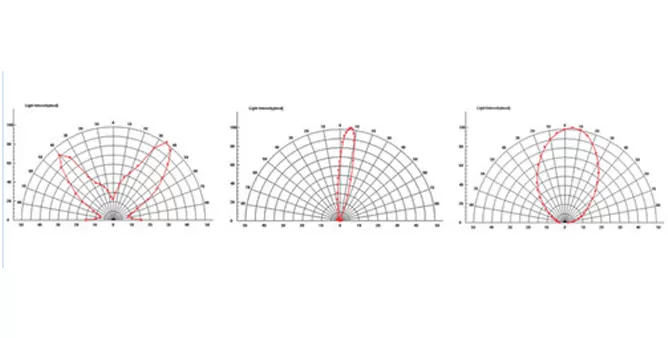
Two-dimensional spatial light distribution
(light distribution) curve
4. The curve showing the relationship between current and luminous flux
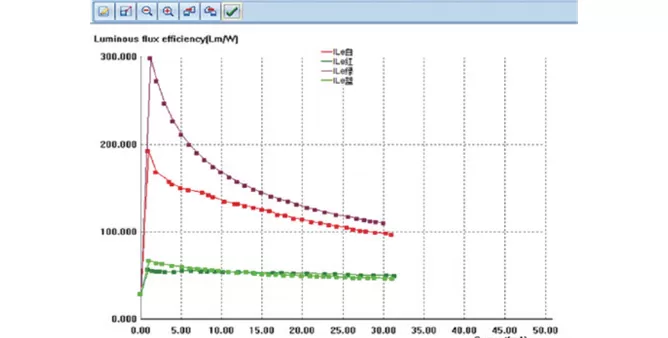
The curve showing the relationship between current and luminous efficiency
5.Measure the chromaticity parameters of different LEDs
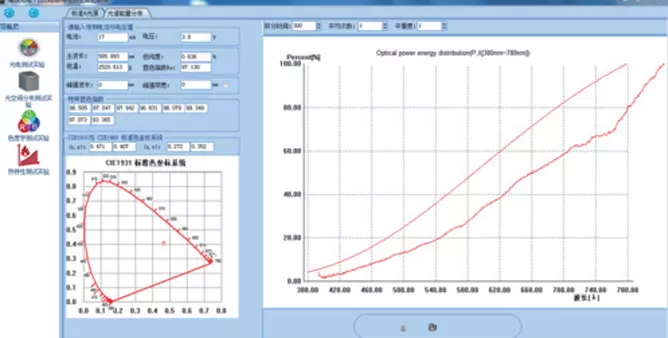
The curve showing the relationship between current and luminous efficiency
6. Thermal Characteristic Test Experiment
This module is used to measure and calculate the K coefficient, thermal resistance, and junction temperature of LEDs. The experimental setup includes a temperature control system, a temperature control power supply, and a pulse power supply. After the experiment begins, the voltage-time curve can be displayed in real time on the software interface, allowing for the analysis of the junction temperature and thermal resistance at the steady state.
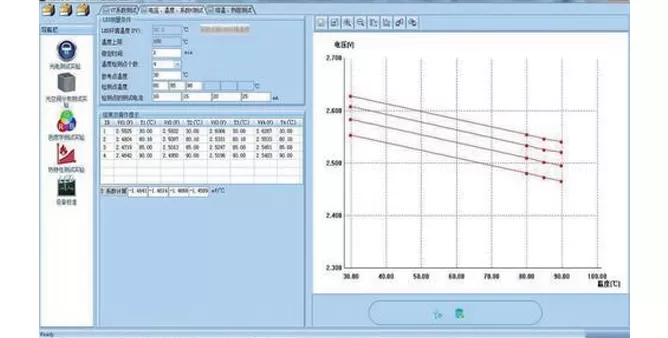
Small current K coefficient test