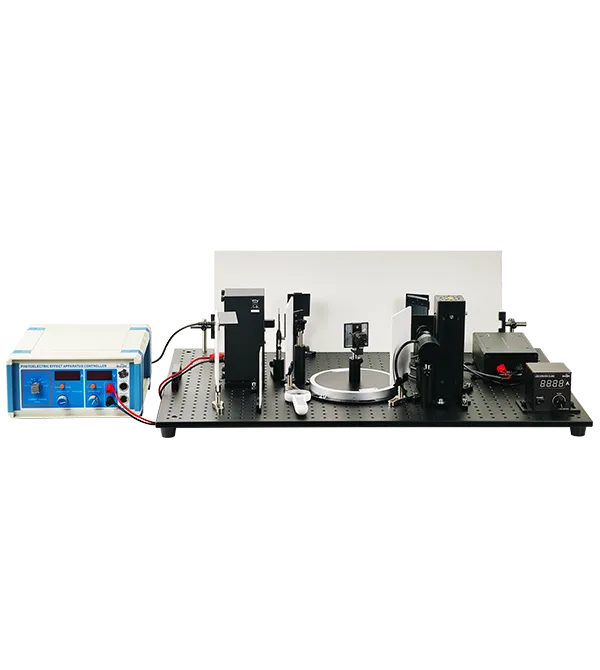
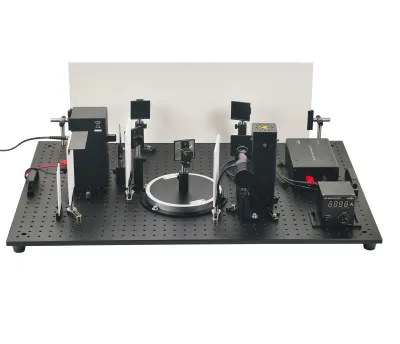
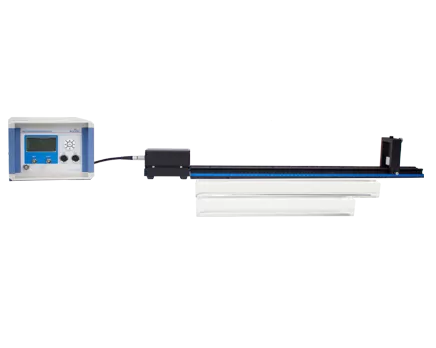
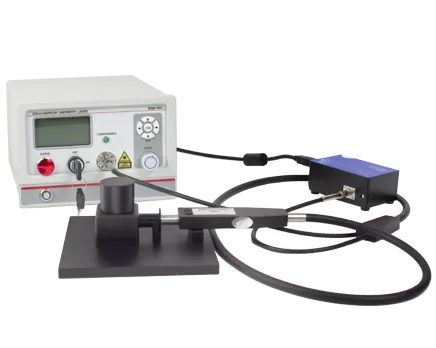
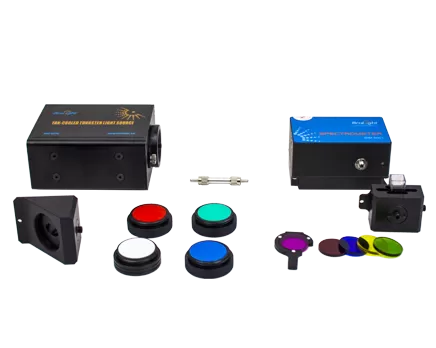
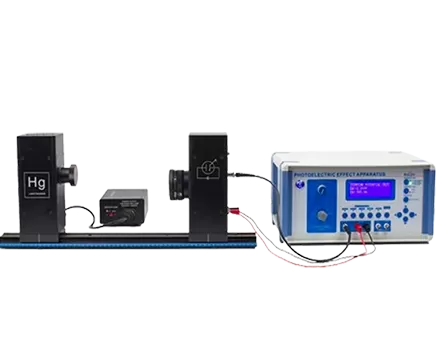
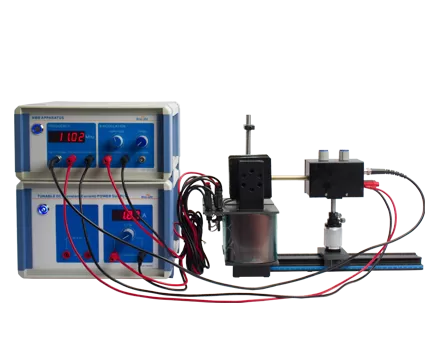
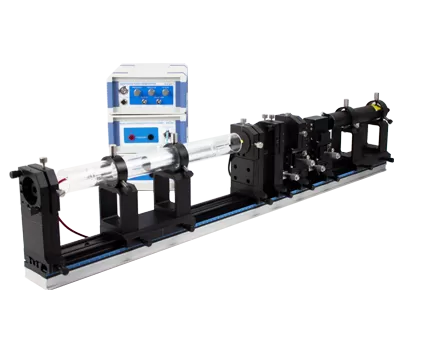
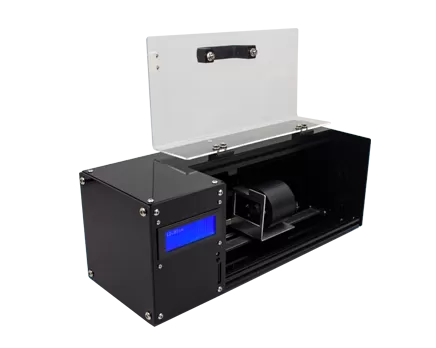
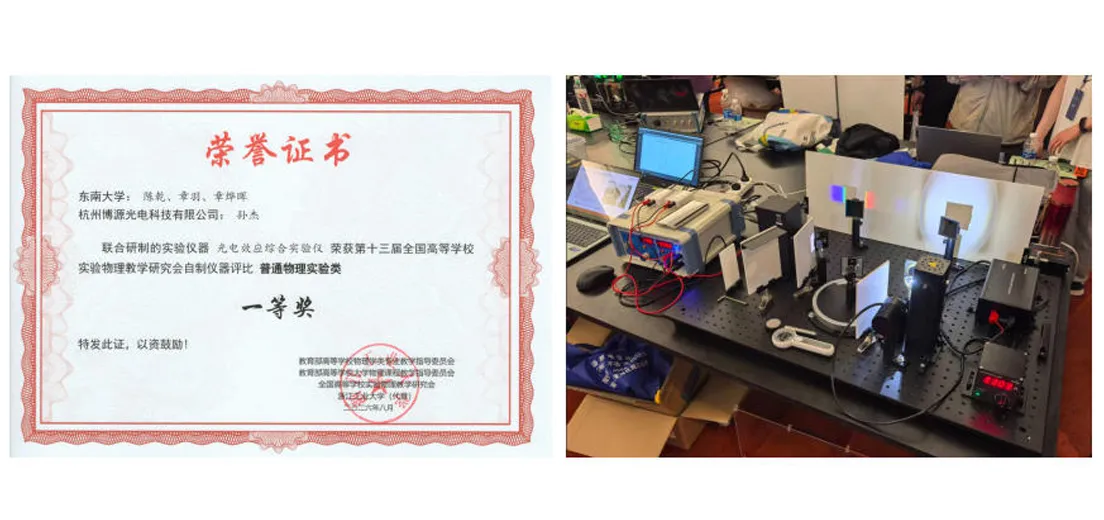
Open-Structure Grating Monochromator – Fully visible optical path for intuitive understanding of dispersion principles

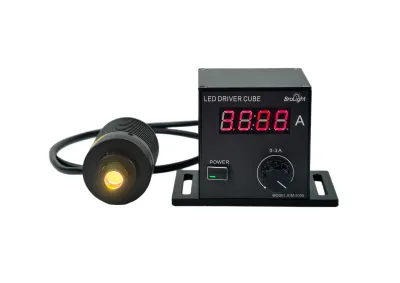
Dual Light Sources – 45° flip mirror for quick switching between mercury lamp (calibration) and LED (continuous scanning)

Continuously Tunable Wavelength – Breaks the 5-wavelength limitation, covering the visible spectrum
Innovative Opto-Mechanical Design: Ensures rapid optical path alignment and high positioning accuracy.

Precision Optical Breadboard – Standard mounting holes for flexible component placement and experiment expansion
Hierarchical Teaching Approach: Rich experiment contents support instructors in designing progressive, multi-level teaching activities.
Observing grating diffraction and understanding the principles of light dispersion
Wavelength calibration of the diffraction grating monochromator
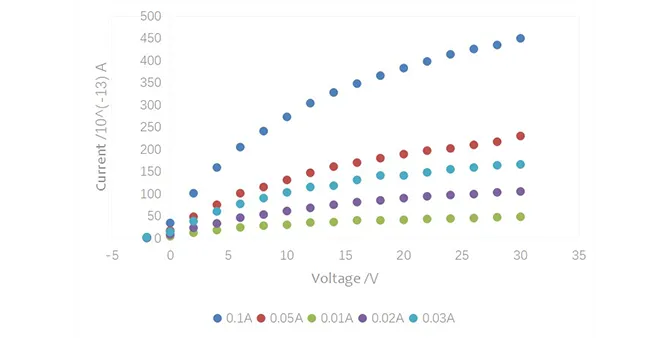
Current-voltage characteristic curve measurement (with different wavelength monochromatic light)
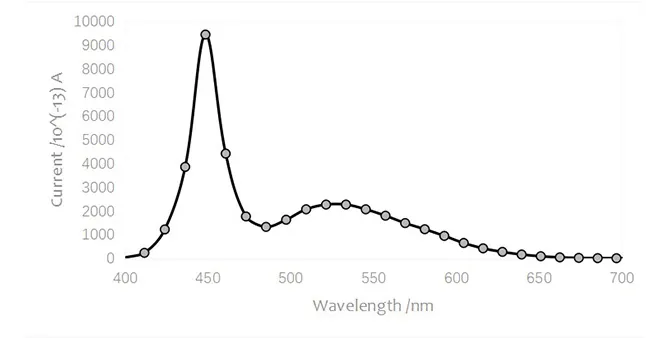
Spectral response characteristic testing of the photocathode (continuous wavelength scanning)
Investigating the relationship between photocurrent and incident light intensity
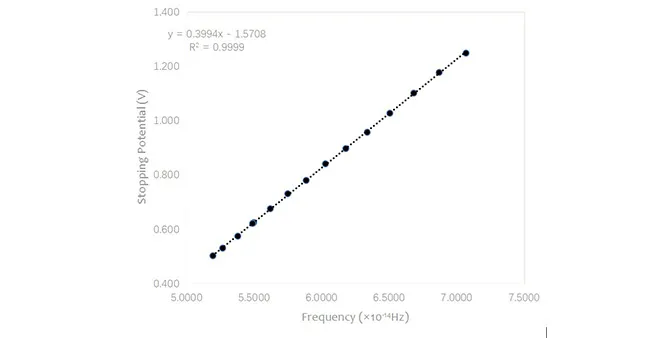
Exploring the variation of stopping potential with incident light frequency
Feature | Traditional Filter-Based Apparatus (e.g., BEX-8504A) | Grating-Based Apparatus (BEX-8518) |
Dispersion Method | Mercury spectral lines + bandpass filters | Reflective diffraction grating monochromator |
Available Wavelengths | Only 5 discrete wavelengths (365nm/405nm/436nm/546nm/577 nm) | Continuously tunable wavelengths (covering visible range) |
Spectral Response Experiments | Not feasible (insufficient data points) | Full spectral response curve achievable |
Optical Path Visibility | Enclosed "black box" | Open optical path, principles fully visible |
Light Source System | Single mercury lamp | Mercury lamp + LED dual source system |
Wave-Particle Duality Verification | Particle nature only (photoelectric effect) | Both wave nature (grating diffraction) and particle nature (photoelectric effect) on a single apparatus |
Inquiry-Based Experiments | Limited | Supports design-oriented and inquiry-based experiments |
Item | Specification |
Dispersion Element | Reflective diffraction grating |
Light Sources | Low-pressure mercury lamp (for wavelength calibration) + Broadband LED (for continuous spectrum) |
Output Wavelength | Continuously tunable (covering visible range) |
Wavelength Calibration | Mercury spectral lines: 365nm, 405nm, 436nm, 546nm, 577 nm |
Optical Platform | Precision optical breadboard with open optical path |
Current Measurement Range | 10⁻⁸ A to 10⁻¹³ A |
Voltage Output Range | -4.5 V to 0 V / -4.5 V to +30 V |
Data Interface | Supports PASCO interface and data acquisition software |
Power Input | 110-120 V / 220-240 V, 50/60 Hz |
No. | Description | Qty. |
1 | Diffraction grating monochromator module (including collimation, dispersion, and focusing elements) | 1 |
2 | Low-pressure mercury lamp source | 1 |
3 | Broadband LED light source | 1 |
4 | Phototube receiver module | 1 |
5 | Precision optical breadboard | 1 |
6 | Diffraction Grating Based Photoelectric Effect Apparatus Controller (including current amplifier and adjustable constant voltage supply) | 1 |
7 | Wavelength adjustment dial | 1 |