EN
EN
 jp
jp  ko
ko  fr
fr  de
de  es
es  tr
tr  ru
ru  pt
pt  ar
ar  vi
vi 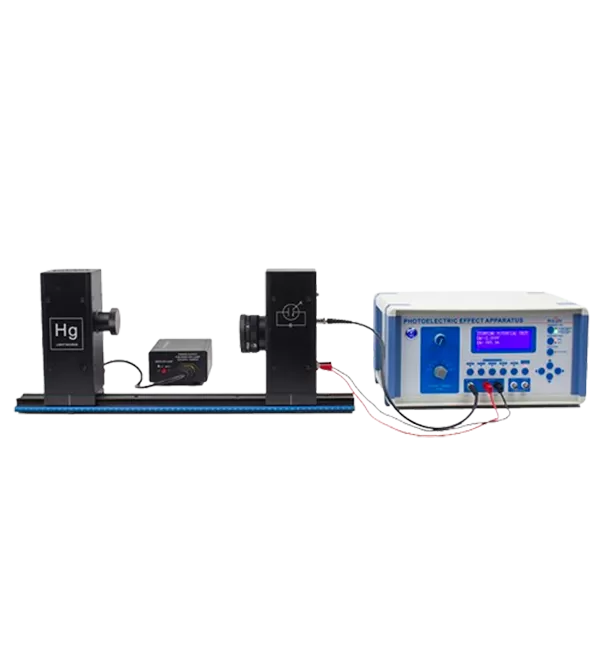
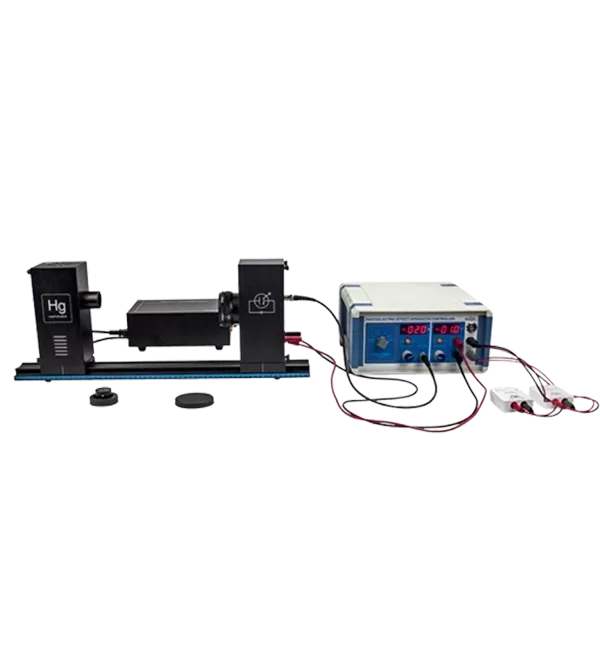


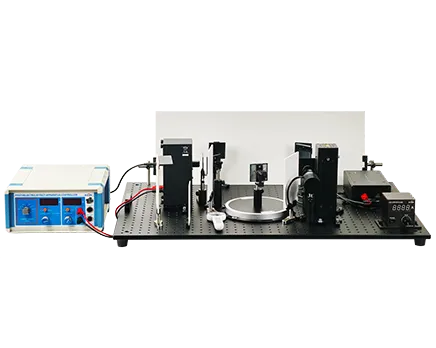
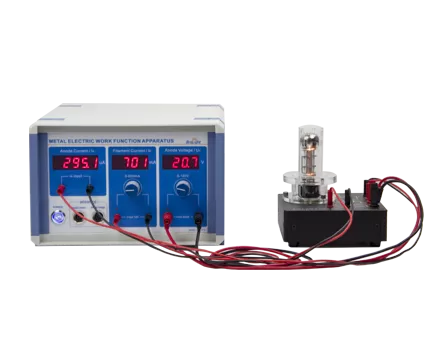
BEX-8504A Photoelectric Effect Experiment Apparatus is designed for university modern physics laboratories to verify Einstein's photoelectric effect and determine Planck's constant. A 50 W mercury lamp, bandpass filters, and interchangeable apertures generate controlled monochromatic illumination for the phototube, while the integrated microcurrent measurement system detects photocurrent across the 10⁻⁸–10⁻¹³ A range.
With five selectable wavelengths from 365 to 577 nm and three aperture sizes, students can investigate the relationship between light frequency, intensity, photocurrent, and stopping voltage. The apparatus supports both Planck constant determination and phototube I-V characteristic experiments with a typical experimental error below 5%.
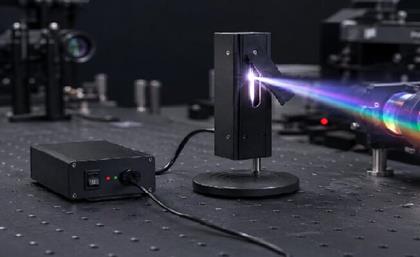
The BEX-8504A photoelectric effect experiment uses a mercury lamp as the light source. Bandpass filters select monochromatic light at 365, 405, 436, 546, or 577 nm, while interchangeable apertures control the amount of light reaching the phototube.
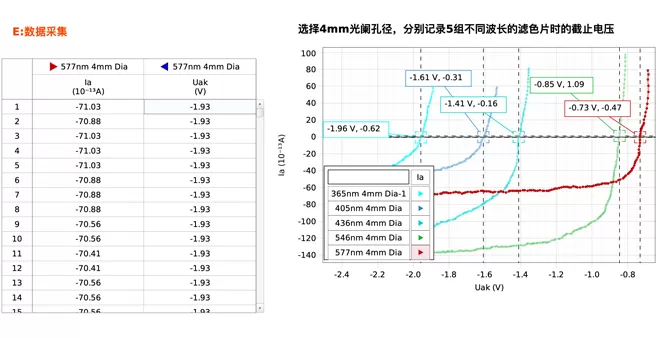
When the selected light illuminates the phototube, photoelectrons are emitted and generate a measurable photocurrent. By adjusting the applied voltage, students can determine the stopping voltage at which the photocurrent approaches zero.
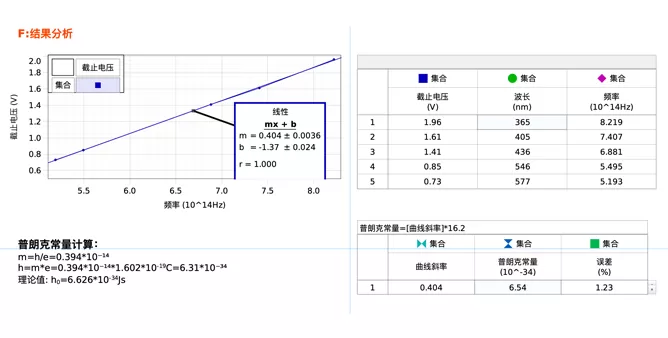
Repeating the measurement at different light frequencies allows students to investigate the relationship between stopping voltage and frequency and experimentally determine Planck's constant. Aperture changes can also be used to study how light intensity affects photocurrent without changing the incident wavelength.
Five Selectable Monochromatic Wavelengths
The apparatus uses narrowband filters to select mercury spectral lines at 365, 405, 436, 546, and 577 nm. These defined wavelengths allow students to compare the photoelectric response at different light frequencies and provide the data required for Planck constant determination.
Adjustable Incident Light Intensity
Three interchangeable apertures with diameters of 2 mm, 4 mm, and 8 mm are provided to change the amount of incident light reaching the phototube.
This enables students to study the relationship between light intensity and photocurrent while keeping the incident wavelength unchanged.
High-Sensitivity Photocurrent Measurement
The integrated measurement system detects currents from 10⁻⁸ to 10⁻¹³ A, supporting the weak photocurrent measurements required in photoelectric effect experiments.
Stable and Adjustable Optical Setup
The mercury lamp and phototube are mounted on a 600 mm optical track, providing a stable experimental arrangement while allowing the source-to-detector geometry to be adjusted when required.
Integrated Experimental Design
The wavelength filters, apertures, phototube, optical track, and electrical measurement components are integrated into a complete teaching system, helping reduce setup complexity for university physics laboratories.
Students measure the stopping voltage at several incident wavelengths and convert each wavelength into its corresponding light frequency. By plotting stopping voltage against frequency, the experimental data can be used to determine Planck's constant and verify Einstein's photoelectric equation. This experiment connects classical laboratory measurements with one of the fundamental concepts of quantum physics.
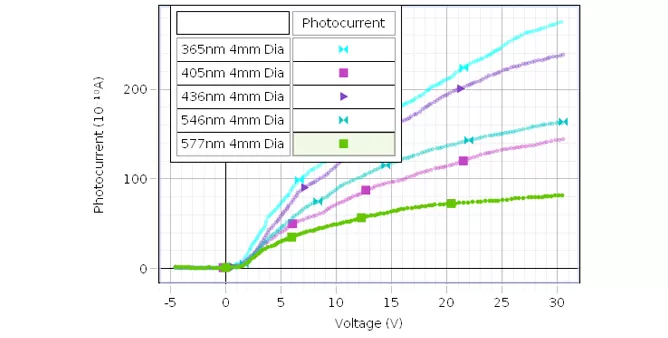
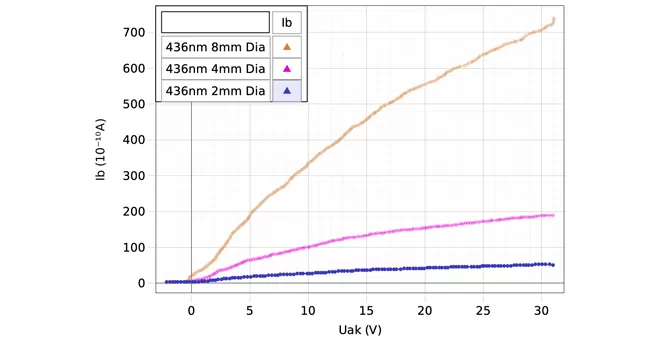
The apparatus can be used to investigate how photocurrent varies as the voltage applied to the phototube changes. Students can observe the response of the phototube under accelerating and retarding voltage conditions and analyze its characteristic current-voltage behavior.
The 2 mm, 4 mm, and 8 mm apertures allow the incident light intensity to be changed without changing the selected mercury wavelength. Students can therefore investigate how photocurrent responds to variations in incident light intensity.
Using the five wavelength filters, students can compare the photoelectric response under 365, 405, 436, 546, and 577 nm illumination. This helps demonstrate that photon energy depends on light frequency rather than simply on the brightness of the incident light.
Study how light frequency and intensity affect electron emission
This is designed to investigate the photoelectric effect, verify Einstein’s photoelectric‑effect equation, determine Planck constant h, plot the volt‑ampere characteristics of phototube and demonstrate the wave‑particle duality of light.
No. | Parts | Key Parameters |
1 | Mercury Lamp Source | 50 W |
2 | General Track, L=600mm | Length: 600 mm |
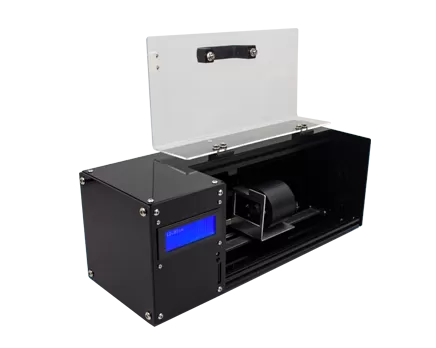
3 | Phototube Box with Filter Set | Optical bandpass Filters: 365, 405, 436, 546, 577 nm Apertures: 2 mm, 4 mm, 8 mm Phototube: Spectral Response Range 300-700 nm |
4 | Mercury Lamp Power Supply | Input: 110-120 VAC / 220-240 VAC, 50/60 Hz; Output: 220 VAC, 50 W |
5 | Photoelectric Effect Experiment Apparatus | Voltage Output: -4.5 – 0 VDC / -4.5 – 30 VDC Current Range: 10⁻⁸ A – 10⁻¹³ A |
No. | Parts | Model | Qty. |
1 | Mercury Lamp Source | BEM-5005 | 1 |
2 | General Track, 600mm | BEM-5201-06 | 1 |
3 | Phototube Box with Filter Set | BEM-5006 | 1 |
4 | Mercury Lamp Power Supply | BEM-5007 | 1 |
5 | Photoelectric Effect Experiment Apparatus | BEM-5710 | 1 |
10 | Power Cord | BC-105075 | 3 |
11 | Connecting Lead, 4mm Sheathed Banana Plugs, Black | BC-105073 | 1 |
12 | Connecting Lead, 4mm Sheathed Banana Plugs, Red | BC-105074 | 1 |
13 | BNC Cable | BC-105076 | 1 |
14 | Communication Cable (8-pin) | BC-105077 | 2 |
A photoelectric effect experiment apparatus is a laboratory system used to investigate electron emission caused by incident light. It typically includes a controlled light source, phototube, wavelength-selection components, voltage control, and a sensitive current measurement system. The experiment allows students to measure quantities such as photocurrent and stopping voltage and to investigate the relationship between light frequency and electron energy.